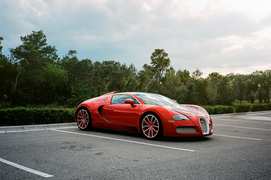
Czinger 21C VMax: When Cutting-Edge Technology Meets Unapologetic Hypercar Madness
For years, the automotive world has anticipated the moment when cutting-edge additive manufacturing—3D printing for the masses, specifically—would finally deliver on its promise of radical hypercar innovation. That moment arrived with the Czinger 21C, and subsequently, its unhinged, road-focused sibling, the 21C VMax. This isn’t just another million-dollar toy; it’s the physical manifestation of engineering that exists on the razor’s edge of what’s possible today. It is, quite frankly, both a marvel of modern technology and an exercise in utter automotive insanity. Having spent time behind the wheel of this radical machine, I can attest that the results are less like driving a car and more like commandeering an alien spacecraft designed for the most brutal asphalt battlegrounds.
Factory Fresh: Welcome to the Future
The journey into the world of Czinger begins before you even sit inside the car. The parent company, Divergent Technologies, operates in a space where military-grade R&D and civilian hypercar production converge. Walking into the Divergent facility required U.S. identification, not because of exclusivity, but because the underlying additive manufacturing technology is trusted by the Department of Defense and various Tier 1 suppliers. While all military hardware was cordoned off, getting a peek inside one of the massive 3D printers was like witnessing the birth of future infrastructure. Lasers fused powdered aluminum into complex, organic shapes that mimicked the delicate strength of bird bones. It’s a visual spectacle that genuinely makes you feel like you’re seeing the automotive landscape of the 2030s, not the 2020s.
CEO Lukas Czinger explained that the factory’s design philosophy is centered on reaching “Pareto optimal” density. In layman’s terms, they engineer components to be so perfectly optimized that adding or removing a single gram negatively impacts the structure. Imagine a small remote reservoir for a rear suspension damper; an engineer specifies the available space and the forces it must withstand, then the AI iterates through hundreds of thousands of designs. The result is an architecture that is both as light as possible and impossibly strong. This isn’t a theoretical pursuit; Divergent’s technology is already trusted by some of the world’s most prestigious automotive OEMs. Aston Martin, Bugatti, and McLaren have all publicly admitted to using Divergent’s additive components. While Ferrari remains tight-lipped, the design of control arms on the F80 certainly hints at similar engineering DNA.
The Anatomy of a Digital Monster: Engine, Drivetrain, and Battery
Czinger offers two distinct flavors of its masterpiece. The standard 21C is a high-downforce, track-focused weapon, while the VMax (short for Veloce Massima) is essentially the road-going variant—an extreme expression of speed with a long tail and a distinct lack of wings. I had the privilege of piloting a silver VMax during the inaugural Velocity Tour, a 500-mile road rally that cut through the rolling hills and wine country of Northern California. The route was chosen deliberately—not to showcase pristine, smooth asphalt, but to put the car’s raw capability to the test on real-world roads that are the antithesis of a modern supercars’ natural habitat.
Getting into the VMax is an experience in itself. The cabin is designed like a fighter jet’s canopy rather than a conventional greenhouse. It feels less like entering a car and more like deploying into a combat zone. The visibility is phenomenal, and while I haven’t personally been in a jet, I did get a ride in an Extra 330LT stunt plane. The sensation of having glass almost surrounding your head with no traditional A-pillars feels remarkably similar. However, the process of entry and exit is frankly ridiculous. You have to plant yourself on the massive sill, pull your knees up to your chin, swivel on your backside, and tuck your feet into the tight footwell before wriggling your head under the roof.
One reason for the oversized sills is that they are crammed with batteries. The 21C VMax is a true hybrid, with each sill housing 2.2 kWh of battery capacity, totaling 4.4 kWh. This isn’t a plug-in hybrid; the battery is charged by the mid-mounted V8 engine. The system is designed to provide up to 500 horsepower to the front wheels, which are driven by two individual motors—one for each wheel. The combustion engine is a Czinger-designed, 2.9-liter twin-turbo V8 that produces a staggering 750 horsepower on California’s standard 91-octane fuel. Upgrade to 100-octane racing fuel, and that number jumps to 850 hp. Czinger also offers ethanol fuel options that promise even more power, though they haven’t released official figures for that setup yet.
The gasoline engine sends its power to the rear wheels through an Xtrac seven-speed automated semi-sequential gearbox. This unit is similar to the gearbox found in the Pagani Utopia, but Czinger takes it a step further. Not only is the transmission case 3D printed using the same additive manufacturing technology, but they also employ small 48-volt electric motors to smooth out shifts at lower speeds. This eliminates the lurching, surging sensation that plagues almost every other automated single-clutch transmission below 30 mph. Thankfully, these actuators work flawlessly at low speeds. Maneuvering into parking lots, navigating traffic, and creeping through hotel garages felt almost normal, a testament to the clever engineering that makes even the most aggressive hypercars tractable in everyday situations.
The Brutal Beauty of Speed
Even with the technological marvels of the 21C VMax, the driving experience is fundamentally visceral and often brutal. For the first day of the rally, I had a professional driver—Evan Jacobs—sitting behind me. Like many ultra-exotic manufacturers (Bugatti and Pagani), Czinger placed a chaperone in the car to ensure I didn’t drive the $2.5 million vehicle off a cliff. Thankfully, later that night, Jacobs assured the Czinger team that I posed no threat and was permitted to drive solo for the remainder of the tour.
We briefly stopped by Laguna Seca for a few parade laps, but Czinger restricts non-employees from driving the VMax on the track, even at the sedate pace required for the rally. This meant my initial track experience was confined to the passenger seat. The first thing to note is that if you have larger calves or wide feet, the rear seat experience is tight. My size XXL calves were practically welded between the carbon fiber tub and the seatback, and my feet felt wedged uncomfortably in the footwell. However, the visibility through the side windows is incredible. Again, it recalled the feeling of being in a stunt plane, offering a uniquely novel perspective on a track environment that I have experienced more than a thousand times.
The true spectacle unfolded when Jacobs convinced the Skip Barber Racing School staff to let him take the VMax for a couple of “6/10ths” hot laps. The most astonishing hot lap I’ve ever experienced was in the Aston Martin Valkyrie LMH race car, during which I could feel the blood pooling in my extremities under the sheer force of braking. The Czinger VMax is now a very close second to that experience. Even at that reduced speed, without the downforce-generating wing, it was easy to understand how the standard 21C achieved the “California Gold Rush.” That name refers to the legendary feat where the standard 21C set five production car track records—at Thunder Hill, Sonoma Raceway, Laguna Seca, Willow Springs, and the Thermal Club—in a single five-day span, driving between each circuit. Later, Czinger returned to Laguna Seca to not only beat its own record but to reclaim the top spot from the Koenigsegg Jesko Sadair’s Spear. That lap, a blistering 1 minute, 22.30 seconds, is faster than the fastest MotoAmerica Superbike lap ever recorded at Laguna (a 1:22.56).
Czinger claims a vehicle weight of approximately 3,600 pounds, which is extraordinarily light for a 1,250-horsepower hybrid vehicle. For perspective, the Ferrari SF90 Stradale Asseto Fiorano—the highest-performance version of a three-motor, twin-turbo V8 PHEV producing 986 horsepower—weighs 3,839 pounds. The new Lamborghini Temerario, another three-motor, twin-turbo V8 (producing less power, but it illustrates the comparison), pushes past the two-ton mark, tipping the scales at 4,185 pounds.
At this point, it’s worth noting that the Ferrari SF90 and Lamborghini Temerario are the two quickest gasoline-powered cars MotorTrend has ever tested (the Ferrari for 0-60 mph, the Lamborghini for the quarter mile). If Czinger’s weight claim holds true, this unconventional California startup has managed to beat two Italian legends with its debut road car. This achievement is remarkable on its own, but even more so considering that Southern California is known for many things, but it is not exactly a traditional hotbed for supercar manufacturing. In other words, Los Angeles is not exactly Modena.
Putting the Metal to the Road: A Test of Extreme Engineering
The route chosen for the rally consisted primarily of winding, back-road asphalt. These were the tight, often poorly maintained, crumbly surfaces that are the stuff

 Czinger 21C VMax: When Cutting-Edge Technology Meets Unapologetic Hypercar Madness
For years, the automotive world has anticipated the moment when cutting-edge additive manufacturing—3D printing for the masses, specifically—would finally deliver on its promise of radical hypercar innovation. That moment arrived with the Czinger 21C, and subsequently, its unhinged, road-focused sibling, the 21C VMax. This isn’t just another million-dollar toy; it’s the physical manifestation of engineering that exists on the razor’s edge of what’s possible today. It is, quite frankly, both a marvel of modern technology and an exercise in utter automotive insanity. Having spent time behind the wheel of this radical machine, I can attest that the results are less like driving a car and more like commandeering an alien spacecraft designed for the most brutal asphalt battlegrounds.
Czinger 21C VMax: When Cutting-Edge Technology Meets Unapologetic Hypercar Madness
For years, the automotive world has anticipated the moment when cutting-edge additive manufacturing—3D printing for the masses, specifically—would finally deliver on its promise of radical hypercar innovation. That moment arrived with the Czinger 21C, and subsequently, its unhinged, road-focused sibling, the 21C VMax. This isn’t just another million-dollar toy; it’s the physical manifestation of engineering that exists on the razor’s edge of what’s possible today. It is, quite frankly, both a marvel of modern technology and an exercise in utter automotive insanity. Having spent time behind the wheel of this radical machine, I can attest that the results are less like driving a car and more like commandeering an alien spacecraft designed for the most brutal asphalt battlegrounds.