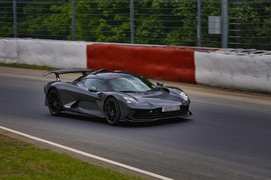
The Aston Martin Valhalla: Navigating the Razor’s Edge of Performance
In the rarefied atmosphere of modern hypercars, where the laws of physics seem to be merely suggestions rather than rigid boundaries, the 2026 Aston Martin Valhalla emerges as a particularly fascinating specimen. Its arrival on the scene, after a gestation period that feels almost as epic as the Norse mythology from which it derives its name, has been accompanied by a flurry of speculation, expectation, and not a little bit of awe.
For those accustomed to the traditional hierarchy of the automotive world, the Valhalla’s positioning in Aston Martin’s lineup is a curiosity. Described by the company itself as its first-ever mid-engine supercar, the distinction is, on the surface, a semantic quibble. Yet, in the context of a market increasingly saturated with machines that blur the lines between road-legal vehicles and pure racing prototypes, the terminology matters. The Valhalla exists in a landscape where the term “hypercar” is no longer the exclusive preserve of the ultrarare, ultrarich, and ultratech.
Aston’s decision to label the Valhalla as a “supercar” is likely a strategic maneuver, a careful calibration of market positioning. In a world where the already legendary Valkyrie sits at the zenith of the hypercar pyramid, the Valhalla must carve out its own niche, a space where exclusivity meets accessibility, and raw performance is tempered with a degree of practicality. It is a delicate balancing act, but one that Aston Martin, with its rich heritage of luxury and performance, is uniquely equipped to execute.
However, to dismiss the Valhalla as merely a scaled-down Valkyrie would be a mistake. While it may be the younger sibling, it possesses its own distinct identity, a unique character that sets it apart from the more extreme creations of its stablemate and the ever-growing roster of hypercar competitors. It is a machine that challenges assumptions, pushes boundaries, and ultimately redefines what we expect from a modern supercar.
The Evolution of a Legend
The journey to the production Valhalla has been a long and winding one, marked by shifts in direction, changes in leadership, and the ever-evolving demands of a rapidly changing automotive landscape. The origins of the project can be traced back to the 2019 Geneva Motor Show, where Aston Martin unveiled what was then known as the AM-RB 003.
The original name was a nod to the automaker’s sponsorship ties with the Red Bull Racing Formula 1 team, a collaboration that had already yielded the groundbreaking Valkyrie. However, the automotive world does not stand still, and Aston’s relationship with Red Bull eventually came to an end following the 2020 F1 season. This partnership shift also coincided with a period of internal restructuring at Aston Martin, as the company navigated a turbulent transition under new leadership.
One of the most significant changes during this period was the evolution of the Valhalla’s powertrain. Initially envisioned as an in-house-designed, turbocharged 3.0-liter V-6, the Valhalla ultimately adopted a hybrid powertrain derived from the Mercedes-AMG GT Black Series. This decision represented a significant departure from the original concept, but it also reflected the increasingly electrified nature of the automotive industry.
The Mercedes-AMG GT Black Series-derived twin-turbo V-8 has been substantially modified for the Valhalla, with Aston engineers incorporating larger turbos, a new inlet manifold, stronger pistons, and different camshafts. These upgrades result in a significant increase in power output, pushing the Valhalla into the hypercar realm even before the addition of its electric motors. This commitment to performance evolution is a hallmark of modern automotive engineering, where incremental improvements in hardware and software can yield dramatic improvements in overall capability.
The All-Important Hybrid System
The hybrid system of the Aston Martin Valhalla is a key differentiator, distinguishing it from many of its traditional supercar competitors. The powertrain combines a flat-plane-crank, dry-sump, twin-turbo 4.0-liter V-8 with a total of 248 horsepower provided by three electric motors. These motors are strategically placed on the front axle and integrated into the new eight-speed dual-clutch gearbox, providing torque vectoring and all-wheel-drive capability.
The hybrid system is powered by a 560-cell battery pack, which is kept cool by immersing the cells in dielectric oil. According to Aston’s chief engineer, this cooling solution allows for rapid charging and discharging of electrical energy, making it particularly well-suited for track use. Unlike the original Valhalla concept, the production model is also a plug-in hybrid, capable of driving in EV-only mode for up to 8.7 miles with a top speed of 80 mph. This added versatility positions the Valhalla as a more usable and environmentally conscious option for discerning buyers.
However, the integration of hybrid technology into a high-performance supercar is not without its challenges. The addition of battery packs and electric motors adds weight to the vehicle, and engineers must work diligently to minimize this impact while maximizing the performance benefits. The Valhalla’s carbon-fiber monocoque construction plays a crucial role in this effort, providing a lightweight and rigid platform that can support the complex hybrid powertrain.
The Interior Experience: A Modern Masterpiece
One of the most striking aspects of the Aston Martin Valhalla is its interior, a space that masterfully blends the functionality of a race car with the luxury of a grand tourer. The driving position is deeply reclined, with the driver sitting in a low-slung seat that is bolted directly into the carbon-fiber monocoque tub. This seating position provides a commanding view of the road and enhances the feeling of connection to the vehicle.
The absence of backrest angle adjustment and seat sliding mechanisms is a deliberate design choice, reflecting the Valhalla’s focus on performance over comfort. Instead of motors, the driver adjusts the seating position using a leather strap that runs between the legs, pulling or pushing the seat to achieve the desired fit. While this might seem unorthodox, it is a testament to Aston’s commitment to engineering innovation and functional design.
The interior design of the Valhalla is a testament to the company’s heritage of luxury craftsmanship. The use of premium materials such as leather, Alcantara, and carbon fiber creates a sophisticated and inviting atmosphere. The dashboard is dominated by a large central touchscreen that controls the infotainment system and various vehicle settings. The steering wheel is ergonomically designed, with a flat bottom and integrated controls that provide easy access to the car’s various functions.
The one area where the interior falls short is luggage storage. Due to the placement of the electric motors and suspension components, there is no frunk, and the available storage space is limited to small cubbies in the door cards. This is a minor inconvenience for a vehicle that is primarily designed for performance driving, but it is worth noting for those who prioritize practicality and versatility.
Performance on the Road: A Thrilling Experience
The Aston Martin Valhalla’s performance on the road is nothing short of spectacular. The 4.0-liter twin-turbo V-8 engine produces 817 horsepower, and when combined with the 248 horsepower from the electric motors, the total output is an impressive 1,064 horsepower and 811 lb-ft of torque. This immense power is delivered to the wheels through a new eight-speed dual-clutch transmission, which provides lightning-fast shifts and seamless power delivery.
The Valhalla’s suspension system, a hybrid of Bilstein DTX active dampers and a five-link rear setup, provides a smooth and comfortable ride despite the car’s performance capabilities. The suspension is adjustable, with Sport and Sport+ modes that offer varying levels of damping and ride height. Race mode introduces a stiffer ride that is best suited for track use, but it is still usable on the road, especially on well-maintained, fast-sweeping roads.
The steering is precise and intuitive, with a weighted feel that provides a strong sense of connection to the road. The active aerodynamics and torque vectoring system work together to provide a stable and predictable driving experience. The Valhalla takes corners with confidence, allowing the driver to push harder and harder without ever feeling like the car is about to lose control.
However, the Valhalla’s soundtrack is not one that will be remembered for the ages. While it is loud without being over the top, the sound is a complex mix of electric motors, turbos, induction, and exhaust. There is a lot going on, and not always for the audibly better. For those who prioritize engine noise and exhaust notes, the Valhalla may not be the best choice.
Performance on the Track: A Masterclass in Handling
The Aston Martin Valhalla truly shines on the racetrack, where its performance capabilities are pushed to the limit. The hybrid system’s Race mode meters the electric assist via a recharge strategy that holds back up to 15 percent state of charge, preventing the battery from ever running out and relying solely on the combustion engine. This ensures consistent performance throughout the lapping session, a crucial advantage on the track.
The Valhalla’s aerodynamics play a significant role in its on-track performance. The underbody front wing and deployable rear wing adjust positions based on speed and dynamic conditions, providing stable downforce without discombobulated shifting of the aerodynamic center of pressure. At 124 mph, the Valhalla generates 935 pounds of downforce, and at 149 mph, it produces a maximum of 1,345 pounds, a figure that remains constant all the way to the car’s top speed of 217 mph.
This aerodynamic prowess, combined with the torque-vectoring system, provides a stable, predictable

 The Aston Martin Valhalla: Navigating the Razor’s Edge of Performance
In the rarefied atmosphere of modern hypercars, where the laws of physics seem to be merely suggestions rather than rigid boundaries, the 2026 Aston Martin Valhalla emerges as a particularly fascinating specimen. Its arrival on the scene, after a gestation period that feels almost as epic as the Norse mythology from which it derives its name, has been accompanied by a flurry of speculation, expectation, and not a little bit of awe.
For those accustomed to the traditional hierarchy of the automotive world, the Valhalla’s positioning in Aston Martin’s lineup is a curiosity. Described by the company itself as its first-ever mid-engine supercar, the distinction is, on the surface, a semantic quibble. Yet, in the context of a market increasingly saturated with machines that blur the lines between road-legal vehicles and pure racing prototypes, the terminology matters. The Valhalla exists in a landscape where the term “hypercar” is no longer the exclusive preserve of the ultrarare, ultrarich, and ultratech.
Aston’s decision to label the Valhalla as a “supercar” is likely a strategic maneuver, a careful calibration of market positioning. In a world where the already legendary Valkyrie sits at the zenith of the hypercar pyramid, the Valhalla must carve out its own niche, a space where exclusivity meets accessibility, and raw performance is tempered with a degree of practicality. It is a delicate balancing act, but one that Aston Martin, with its rich heritage of luxury and performance, is uniquely equipped to execute.
However, to dismiss the Valhalla as merely a scaled-down Valkyrie would be a mistake. While it may be the younger sibling, it possesses its own distinct identity, a unique character that sets it apart from the more extreme creations of its stablemate and the ever-growing roster of hypercar competitors. It is a machine that challenges assumptions, pushes boundaries, and ultimately redefines what we expect from a modern supercar.
The Evolution of a Legend
The Aston Martin Valhalla: Navigating the Razor’s Edge of Performance
In the rarefied atmosphere of modern hypercars, where the laws of physics seem to be merely suggestions rather than rigid boundaries, the 2026 Aston Martin Valhalla emerges as a particularly fascinating specimen. Its arrival on the scene, after a gestation period that feels almost as epic as the Norse mythology from which it derives its name, has been accompanied by a flurry of speculation, expectation, and not a little bit of awe.
For those accustomed to the traditional hierarchy of the automotive world, the Valhalla’s positioning in Aston Martin’s lineup is a curiosity. Described by the company itself as its first-ever mid-engine supercar, the distinction is, on the surface, a semantic quibble. Yet, in the context of a market increasingly saturated with machines that blur the lines between road-legal vehicles and pure racing prototypes, the terminology matters. The Valhalla exists in a landscape where the term “hypercar” is no longer the exclusive preserve of the ultrarare, ultrarich, and ultratech.
Aston’s decision to label the Valhalla as a “supercar” is likely a strategic maneuver, a careful calibration of market positioning. In a world where the already legendary Valkyrie sits at the zenith of the hypercar pyramid, the Valhalla must carve out its own niche, a space where exclusivity meets accessibility, and raw performance is tempered with a degree of practicality. It is a delicate balancing act, but one that Aston Martin, with its rich heritage of luxury and performance, is uniquely equipped to execute.
However, to dismiss the Valhalla as merely a scaled-down Valkyrie would be a mistake. While it may be the younger sibling, it possesses its own distinct identity, a unique character that sets it apart from the more extreme creations of its stablemate and the ever-growing roster of hypercar competitors. It is a machine that challenges assumptions, pushes boundaries, and ultimately redefines what we expect from a modern supercar.
The Evolution of a Legend