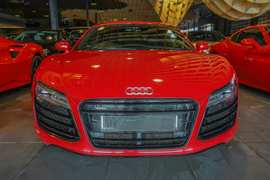
The Aston Martin Valhalla: A Modern Performance Powerhouse That Redefines the Supercar Experience
Aston Martin’s latest hypercar, the Valhalla, combines mind-bending power with cutting-edge technology, proving that performance has reached new heights in 2025 and beyond.
An Inevitable Question
When you experience Aston Martin’s latest creation—a machine that pushes the boundaries of what’s possible in automotive engineering—the immediate question that arises is, “How was it?” For those lucky enough to get behind the wheel of the 2026 Aston Martin Valhalla, the answer is as profound as it is simple: exactly as you expect, but only if you’ve already experienced the pinnacle of modern performance cars.
This question, now a decades-long tradition among auto publications reviewing supercars, has become increasingly surreal in recent years. So much so that when multiple friends and colleagues asked me about the Valhalla, I hesitated to answer with a simple, “It was amazing.” Why? Because explaining the experience of driving a car that produces 1,064 horsepower and reaches 60 mph in under three seconds is akin to explaining color to someone who has only ever seen in black and white. It’s only truly meaningful when you’ve experienced it for yourself.
Seven years is a long time in the automotive world, a span that feels even longer due to the isolating effects of the pandemic years, which warped our perception of time. However, it’s been seven years since Aston Martin first revealed the AM-RB 003 concept at the 2019 Geneva Motor Show.
That original name, which has since been replaced by a moniker from Norse mythology—Valhalla, the glorious afterlife realm where heroic dead warriors’ spirits go to prepare for an epic final battle (and which conveniently begins with a V, adhering to Aston’s naming traditions)—reflects the automaker’s ties to the Red Bull Racing Formula 1 team at the time.
A Lot Has Changed
Much has evolved since that reveal, and not just the name. Aston and Red Bull parted ways after the 2020 F1 season when Aston’s then-new boss, Lawrence Stroll, rebranded his Racing Point F1 team as the famous British marque. More importantly, the automotive landscape has undergone rapid transformation, and Aston Martin has been at the forefront of these changes.
The company experienced significant internal turnover, and the Valhalla’s hybrid powertrain—initially planned as a custom-designed, turbocharged 3.0-liter V-6 with performance comparable to other high-performance hybrid hypercars like the LaFerrari and Porsche 918 Spyder—was eventually replaced by a hybrid setup based on the Mercedes-AMG GT Black Series’ twin-turbo V-8. Compared to the GT Black Series, Aston enhanced this engine with larger turbos, a new intake manifold, upgraded pistons, and different camshafts to boost power by nearly 100 hp and 50 lb-ft. The Valhalla is the exclusive home of this engine.
When I first sat in a prototype of the Valhalla at the Pebble Beach Concours in August 2022, giggling at the F1-inspired reclined and elevated-leg seating position, the projected specs for the V-8-based powertrain had jumped from 937 hp and 738 lb-ft of torque to 1,012 hp, with no torque figure specified. Aston emphasized that these figures were not finalized, but they were more than enough to make me ask, “Please, I want to drive it, whenever it’s ready.”
Worth the Wait…
Based on what Aston Martin shared about the Valhalla’s development cycle back then, I didn’t expect another three and a half years to pass before I had the chance. However, the final production version’s hardware exceeds all those earlier expectations.
The flat-plane-crank, dry-sump, twin-turbo 4.0-liter V-8 produces 817 hp. Combined with 248 hp from two Aston-designed radial-flux permanent-magnet electric motors on the front axle and a third motor integrated into the new eight-speed dual-clutch gearbox (a first for Aston), the total output reaches 1,064 hp and 811 lb-ft.
In addition to the motors, the hybrid system features a 560-cell battery pack. Engineers report that this is an off-the-shelf AMG battery, which is the only component of the hybrid system that Aston does not manufacture themselves. According to chief engineer Andrew Kay, “We’re able to push energy into the battery and cycle it out very quickly [meaning recharge and deployment of electrical energy]. This is very good for track use, in particular.”
Unlike the original Valhalla concept and its larger sibling, the Valkyrie, the production model is also a plug-in hybrid. It can run in EV-only mode for up to 8.7 miles and has a top speed of 80 mph.
…But Something Else Happened Along the Way
Some readers might take issue with the use of the term “supercar” to describe the Valhalla. However, the company itself refers to the Valhalla as its first-ever mid-engine supercar. But isn’t it a hypercar?
Yes, except for the existence of the Valkyrie, which restricts marketing language about “first ever” achievements. According to the company, the Valkyrie’s price tag of over $3 million and limited production run of 285 units make the Valhalla’s $1-million-plus MSRP and 999-unit inventory seem relatively pedestrian in comparison.
Of course, this sounds absurd in the real world, but it speaks to a larger trend in modern high-performance automobiles—both in terms of price and capability.
Millennials, Zoomers, and Gen Alpha enthusiasts may be accustomed to seeing new million-dollar cars flooding their social media feeds on a seemingly weekly basis. Each new model boasts unheard-of power and torque figures, acceleration times, and a list of tech specs, features, options, and bespoke luxury choices as long as the Nürburgring’s endurance circuit.
However, for those who are older but not yet AARP members, it’s easy to remember the shockwave caused by something like the 627-hp, $800,000-ish McLaren F1 in 1993–94. Even more shocking was the Bugatti Veyron just 20 years ago, generally considered the first million-dollar, 1,000-hp hypercar.
Fast forward to today: since I sat in the Valhalla prototype at Pebble Beach, Aston Martin has launched the Ferrari F80, the 849 Testarossa, the Czinger 21C VMax, and even the more “mainstream but blindingly fast” Porsche 911 Turbo S. Hell, you can buy a hybrid Corvette ZR1X with 1,250 hp, something no one could have predicted when the Valhalla was just a brilliant concept in Aston Martin’s and its now-Aston F1 managing technical partner Adrian Newey’s collective minds.
Just Drive It
With this context in mind, the saying “comparison is the thief of joy” becomes especially relevant in the world of supercars and hypercars. It also happens to be fitting here because orchestrating a proper comparison test among the vehicles listed above is nearly impossible. Ferrari, for instance, has long been reluctant to provide publications like ours with cars for head-to-head showdowns. (Shame on you, Ferrari.)
No matter, because given how high the dynamic limits are, driving something like the Valhalla on its own merits and experiencing what it has to offer is a far more rewarding endeavor.
Make no mistake: the overall experience matters in a car like this. For a long time, it hasn’t been enough for a car to be pleasant and thrilling on the road while performing like an understeering mess on the track, or be mesmerizing on the track but a chiropractor’s dream on the road. We already knew, mostly, that this Aston Martin was a winner on all fronts after MotorTrend’s Angus MacKenzie tested a “prototype” that was essentially the finished article, save for some transmission calibration, a few months prior.
On the Road
Unlike Angus, who only drove it on the Silverstone Circuit’s short Stowe layout in the U.K., Aston arranged a 50-minute road loop for me to begin with. Looking at the Valhalla’s Le Mans Hypercar-esque appearance and low, wide stance, one might expect a compromised daily driver. However, that’s not the case at all. The only exception is the utter lack of luggage storage. There are some small cubbies in the door cards, but no frunk because that potential cargo space is occupied by three high-temperature radiators, the electric motors, and a racing-style, pushrod-actuated horizontally mounted inboard suspension system.
Aston executed the latter solution partly because of the F1-style driving position. You sit so low that a conventional suspension would have raised the bodywork height too much to maintain a clear sightline ahead. There’s no backrest angle adjustment, so you must adapt to the seating position. The seats are bolted so low into the carbon-fiber monocoque tub that there’s no motor beneath them to slide yourself forward and back. Instead, you pull a leather strap between your legs and push to move the seats forward and backward.
You get used to the driving position quickly—it’s not as extreme as it seems—and you realize within

 The Aston Martin Valhalla: A Modern Performance Powerhouse That Redefines the Supercar Experience
Aston Martin’s latest hypercar, the Valhalla, combines mind-bending power with cutting-edge technology, proving that performance has reached new heights in 2025 and beyond.
An Inevitable Question
When you experience Aston Martin’s latest creation—a machine that pushes the boundaries of what’s possible in automotive engineering—the immediate question that arises is, “How was it?” For those lucky enough to get behind the wheel of the 2026 Aston Martin Valhalla, the answer is as profound as it is simple: exactly as you expect, but only if you’ve already experienced the pinnacle of modern performance cars.
This question, now a decades-long tradition among auto publications reviewing supercars, has become increasingly surreal in recent years. So much so that when multiple friends and colleagues asked me about the Valhalla, I hesitated to answer with a simple, “It was amazing.” Why? Because explaining the experience of driving a car that produces 1,064 horsepower and reaches 60 mph in under three seconds is akin to explaining color to someone who has only ever seen in black and white. It’s only truly meaningful when you’ve experienced it for yourself.
Seven years is a long time in the automotive world, a span that feels even longer due to the isolating effects of the pandemic years, which warped our perception of time. However, it’s been seven years since Aston Martin first revealed the AM-RB 003 concept at the 2019 Geneva Motor Show.
The Aston Martin Valhalla: A Modern Performance Powerhouse That Redefines the Supercar Experience
Aston Martin’s latest hypercar, the Valhalla, combines mind-bending power with cutting-edge technology, proving that performance has reached new heights in 2025 and beyond.
An Inevitable Question
When you experience Aston Martin’s latest creation—a machine that pushes the boundaries of what’s possible in automotive engineering—the immediate question that arises is, “How was it?” For those lucky enough to get behind the wheel of the 2026 Aston Martin Valhalla, the answer is as profound as it is simple: exactly as you expect, but only if you’ve already experienced the pinnacle of modern performance cars.
This question, now a decades-long tradition among auto publications reviewing supercars, has become increasingly surreal in recent years. So much so that when multiple friends and colleagues asked me about the Valhalla, I hesitated to answer with a simple, “It was amazing.” Why? Because explaining the experience of driving a car that produces 1,064 horsepower and reaches 60 mph in under three seconds is akin to explaining color to someone who has only ever seen in black and white. It’s only truly meaningful when you’ve experienced it for yourself.
Seven years is a long time in the automotive world, a span that feels even longer due to the isolating effects of the pandemic years, which warped our perception of time. However, it’s been seven years since Aston Martin first revealed the AM-RB 003 concept at the 2019 Geneva Motor Show.