The Aston Martin Valhalla: A Glimpse into the Future of Performance
Answering the inevitable question, “So, how was the Aston Martin Valhalla?” is harder than you’d expect. After driving this nearly $1.1 million, 1,064-horsepower machine, the honest answer feels oddly insufficient: “Exactly how you’d think it would be.” But in the 2020s, that statement requires a level of context that only comes from experiencing the absolute pinnacle of automotive engineering firsthand. The Valhalla isn’t just a car; it’s a statement. It pushes the boundaries of what we thought was possible on public roads and racetracks, challenging the very notion of what a modern supercar can be.
Years in the Making
It has been seven years since Aston Martin first unveiled what was then known as the AM-RB 003 at the 2019 Geneva Motor Show. Back then, the name was a nod to the car’s sponsorship ties to the Red Bull Racing Formula 1 team, and the powertrain was expected to be an in-house designed, turbocharged 3.0-liter V-6. However, the automotive landscape changed dramatically in the intervening years. Aston Martin and Red Bull parted ways after the 2020 F1 season, and the Valhalla’s powertrain evolved into a hybridized Mercedes-AMG GT Black Series-derived twin-turbo V-8. Aston enhanced the engine with bigger turbos, a new intake manifold, stronger pistons, and different camshafts, bumping the output to nearly 100 horsepower and 50 pound-feet more than the AMG donor.
When Aston provided a mockup of the car at the Pebble Beach Concours in August 2022, the projected specs had jumped to a combined 1,012 horsepower and an undisclosed torque figure. Even then, Aston stressed that the powertrain was not finalized, but the team was confident they would deliver an experience that would change the game. Little did we know how much they would exceed expectations.
A Hybrid Heartbeat
The production Valhalla is powered by a flat-plane-crank, dry-sump, twin-turbo 4.0-liter V-8 engine that produces 817 horsepower. It’s augmented by a hybrid system that includes three Aston-designed radial-flux permanent-magnet electric motors: two on the front axle and one mounted to a new eight-speed dual-clutch gearbox. These motors provide a combined 248 horsepower, bringing the total output to 1,064 horsepower and 811 pound-feet of torque.
Unlike the original concept and its big brother, the Valkyrie, the production Valhalla is a plug-in hybrid, capable of driving in EV-only mode for up to 8.7 miles and reaching a top speed of 80 mph. The hybrid system is built around a 560-cell battery pack, which Aston engineers say is an off-the-shelf AMG unit, the only part of the hybrid system not produced by Aston Martin. The cells are fully immersed in dielectric oil, a cooling solution that allows engineers to push energy into the battery and cycle it out very quickly. This is particularly beneficial for track use, as the battery can recharge and discharge electrical energy with extreme speed, maintaining performance even under demanding conditions.
Redefining the Supercar
While some might argue the term “supercar” is now too tame for a machine with over 1,000 horsepower, Aston Martin has labeled the Valhalla its first-ever mid-engine supercar. This distinction is largely due to the existence of the Valkyrie, which sits in a higher stratum of performance and price. With a starting price north of $3 million and a limited run of only 285 examples, the Valkyrie is a barely street-legal race car. In contrast, the Valhalla, with its million-dollar price tag and production run of 999 units, feels almost pedestrian in comparison.
This absurd comparison speaks volumes about the current state of high-performance automobiles. For younger generations, it’s common to see yet another million-dollar car on social media, boasting unprecedented power and torque figures, advanced technology, and bespoke luxury options that would make your head spin. But for older enthusiasts, it’s easy to recall the shockwave created by the 627-hp, $800,000-ish McLaren F1 in the 1990s, or even the Bugatti Veyron, which became the first million-dollar, 1,000-hp hypercar only two decades ago.
Today, the lines between automotive categories blur. Since the Valhalla prototype was revealed, we’ve driven the Porsche 911 GT3 RS, a car that boasts about half the horsepower but incorporates so much race-derived aerodynamics and technology that it requires pro-racer skills to maximize on the track. The 911 GT3 RS’s suitability as a daily driver remains up for debate.
Stepping up in price, construction, and technological prowess, the automotive world has introduced vehicles like the Ferrari F80, the 849 Testarossa, the Czinger 21C VMax, and even the “mundane” yet blindingly fast Porsche 911 Turbo S. And as if that weren’t enough, you can now buy a hybrid Corvette ZR1X with 1,250 horsepower—a concept no one envisioned when the Valhalla was just an idea in Aston Martin’s and Adrian Newey’s minds.
The Driving Experience: Road Manners
With so much competition in the hypercar space, it’s no longer enough for a car to be fast. It needs to deliver an engaging experience on public roads and a commanding performance on the racetrack. Aston Martin has clearly focused on making the Valhalla a winner on all fronts.
Our introduction to the Valhalla was a 50-minute road loop in Spain. Despite its Le Mans Hypercar appearance and low, wide stance, the Valhalla is surprisingly compliant as a daily driver. The only exception is the lack of luggage space. While there are small cubbies in the door cards, the frunk is occupied by three high-temperature radiators, electric motors, and a racing-style, pushrod-actuated inboard suspension layout. This suspension design was chosen to maintain a clear sightline ahead, given the F1-style seating position where the driver sits extremely low.
The seating position itself is unique. The seats are bolted so low into the carbon-fiber monocoque tub that there’s no motor to slide them forward or back. Instead, you pull a leather strap between your legs and push to adjust your position. While it sounds unusual, it actually works well, and you get used to the driving position quickly. It’s not as extreme as you might think.
A Suspension Worthy of the Price
The real surprise is the suspension. The Valhalla features a Bilstein DTX active damper system and a five-link rear suspension that provide a surprisingly comfortable ride for a car of this caliber. Even on the varied Spanish roads, the suspension proved smooth and refined, with minimal difference between the Sport and Sport+ settings—a trait we’ve praised on other new Aston Martins, such as the Vantage.
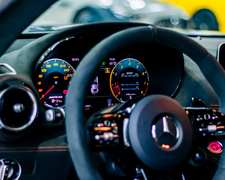
While the Race mode offers a harsher ride that might be tiring for everyday cruising, it’s manageable on well-maintained, sweeping roads when it’s time to push the car. The square-ish steering wheel feels nice in hand, and the molded-in crease up the back of the grip provides a positive feel for your fingers. The steering itself is intuitive and maintains a lovely weight that feels neither too light nor too heavy across all drive modes.
Unrivaled Acceleration
When we found a long, open stretch of country road with no one in sight, we decided to test the Valhalla’s launch control. The car moved off with a slight, controlled wiggle from the rear as the tires found their grip, then simply went. Aston says 0–62 mph happens in 2.5 seconds, meaning a 0–60 mph time of around 2.4 seconds is expected.
The speed is impressive, but what’s truly remarkable is the flat torque curve. 90 percent of the peak 811 lb-ft of torque is available from 2,500 rpm all the way to the 6,700 rpm power peak. The car simply never lets up, pulling with relentless force even at high speeds.
Sound and Sensation
One area where the Valhalla might disappoint purists is the exhaust note. With a redline set to 7,000 rpm, the engine doesn’t reach the ultra-high revs of some other supercars. The sound itself is a complex mix of electric motors, turbos, induction, and exhaust. It’s certainly loud enough when you stomp on the accelerator, but it’s not the kind of symphony you’d put on a list of the greatest engine soundtracks of all time. There’s just a lot going on, and not always in a good way.
The Track Experience
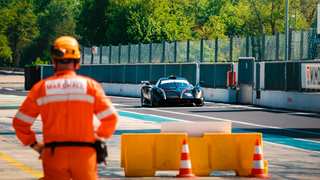
At the Circuito de Navarra in Spain, we had the opportunity to push the Valhalla on a racetrack. This is where the car’s trick torque vectoring, aerodynamics, and braking system truly shine. You’ll want to switch to Race mode for track driving, not just because it’s named that way, but because of how the hybrid system operates.
In Sport+ mode, the car dumps a huge amount of electric boost to the wheels, draining the battery quickly. The brake-by-wire system

 The Aston Martin Valhalla: A Glimpse into the Future of Performance
Answering the inevitable question, “So, how was the Aston Martin Valhalla?” is harder than you’d expect. After driving this nearly $1.1 million, 1,064-horsepower machine, the honest answer feels oddly insufficient: “Exactly how you’d think it would be.” But in the 2020s, that statement requires a level of context that only comes from experiencing the absolute pinnacle of automotive engineering firsthand. The Valhalla isn’t just a car; it’s a statement. It pushes the boundaries of what we thought was possible on public roads and racetracks, challenging the very notion of what a modern supercar can be.
Years in the Making
It has been seven years since Aston Martin first unveiled what was then known as the AM-RB 003 at the 2019 Geneva Motor Show. Back then, the name was a nod to the car’s sponsorship ties to the Red Bull Racing Formula 1 team, and the powertrain was expected to be an in-house designed, turbocharged 3.0-liter V-6. However, the automotive landscape changed dramatically in the intervening years. Aston Martin and Red Bull parted ways after the 2020 F1 season, and the Valhalla’s powertrain evolved into a hybridized Mercedes-AMG GT Black Series-derived twin-turbo V-8. Aston enhanced the engine with bigger turbos, a new intake manifold, stronger pistons, and different camshafts, bumping the output to nearly 100 horsepower and 50 pound-feet more than the AMG donor.
When Aston provided a mockup of the car at the Pebble Beach Concours in August 2022, the projected specs had jumped to a combined 1,012 horsepower and an undisclosed torque figure. Even then, Aston stressed that the powertrain was not finalized, but the team was confident they would deliver an experience that would change the game. Little did we know how much they would exceed expectations.
A Hybrid Heartbeat
The Aston Martin Valhalla: A Glimpse into the Future of Performance
Answering the inevitable question, “So, how was the Aston Martin Valhalla?” is harder than you’d expect. After driving this nearly $1.1 million, 1,064-horsepower machine, the honest answer feels oddly insufficient: “Exactly how you’d think it would be.” But in the 2020s, that statement requires a level of context that only comes from experiencing the absolute pinnacle of automotive engineering firsthand. The Valhalla isn’t just a car; it’s a statement. It pushes the boundaries of what we thought was possible on public roads and racetracks, challenging the very notion of what a modern supercar can be.
Years in the Making
It has been seven years since Aston Martin first unveiled what was then known as the AM-RB 003 at the 2019 Geneva Motor Show. Back then, the name was a nod to the car’s sponsorship ties to the Red Bull Racing Formula 1 team, and the powertrain was expected to be an in-house designed, turbocharged 3.0-liter V-6. However, the automotive landscape changed dramatically in the intervening years. Aston Martin and Red Bull parted ways after the 2020 F1 season, and the Valhalla’s powertrain evolved into a hybridized Mercedes-AMG GT Black Series-derived twin-turbo V-8. Aston enhanced the engine with bigger turbos, a new intake manifold, stronger pistons, and different camshafts, bumping the output to nearly 100 horsepower and 50 pound-feet more than the AMG donor.
When Aston provided a mockup of the car at the Pebble Beach Concours in August 2022, the projected specs had jumped to a combined 1,012 horsepower and an undisclosed torque figure. Even then, Aston stressed that the powertrain was not finalized, but the team was confident they would deliver an experience that would change the game. Little did we know how much they would exceed expectations.
A Hybrid Heartbeat