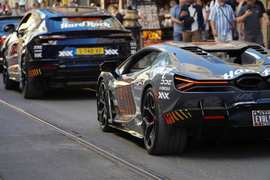
Czinger 21C VMax: The Alien-Tech Hypercar That Rewrites the Rulebook
For years, the automotive world has whispered about Czinger. A company born not of engineering tradition, but of artificial intelligence, 3D printing, and a vision so audacious it bordered on madness. Now, after years of anticipation, the Southern California startup has invited us to experience the peak of their insanity: the 21C VMax. This isn’t just a car; it’s a statement. A gauntlet thrown down in the face of established hypercar giants.
My journey began in a way few journalists ever experience. Forget plush lounges and press kits. Entering the Czinger factory felt less like visiting a car company and more like breaking into Area 51. After showing my U.S. passport—a necessity because the parent company, Divergent Technologies, serves the Department of Defense—I was granted access to a world of iterative AI and industrial-scale 3D printing.
The Future, Additively Manufactured
Lukas Czinger, the young visionary CEO, guided me through the facility. His passion was palpable as he explained the core philosophy: Pareto optimality. In layman’s terms, this is the point where adding any more weight, or taking any away, becomes detrimental. Imagine an engineer calling for a part that must withstand a specific force—say, a rear suspension damper reservoir bracket. Instead of the traditional, often bloated, design process, Divergent’s AI iterates hundreds of thousands of structural variations. The result? A design that mirrors evolution, appearing organic, efficient, and unbelievably strong, yet feather-light.
This technology is far from a novelty. While the VMax gets the spotlight, Divergent serves nine automotive OEMs, including Aston Martin, Bugatti, and McLaren. The Ferrari F80’s control arms bear an uncanny resemblance to Divergent’s work, though the company remains discreet. It’s a sobering reminder that the most radical innovations often happen in the shadows before they hit the public eye.
Under the Hood: A Carbon-Fiber Jet Fighter
Czinger builds two distinct flavors of what is essentially the same car. The 21C is the high-downforce, track-focused monster—the one that recently conquered the California Gold Rush, setting five production car track records in five days. But for my road rally, I was piloting the 21C VMax: a sleek, wingless version designed for the road.
Calling the cabin a “greenhouse” would be an insult. It’s a canopy. As Czinger states, it feels like being in a jet fighter. I’ve been inside an Extra 330LT stunt plane, and the comparison is uncanny. Glass less than a foot from either side of your head, a feeling of being exposed yet protected. The visibility is breathtaking, but the process of entry and exit is anything but graceful. Imagine sitting on a massive sill, pulling your knees to your chest, and spinning on your backside while tucking your feet into the footwell—all before sliding your head under the roof. It’s ridiculous, but undeniably cool.
The reason for the massive sills? Batteries. The VMax is a hybrid hypercar where each sill houses 2.2 kWh of power, totaling 4.4 kWh. It’s not a plug-in hybrid; a mid-mounted V8 keeps the pack charged. This setup allows for a staggering 500 horsepower from the front axle, powered by dual electric motors.
The combustion heart is a Czinger-designed 2.9-liter twin-turbo V8 producing 750 hp on 91-octane fuel. Bump that to 100-octane race fuel, and the output jumps to 850 hp. Czinger has also explored ethanol, suggesting a 10% power boost, but the production numbers remain locked away. The sheer engineering prowess in this powertrain is staggering, especially given the car’s target curb weight of just 3,600 pounds. To put that in perspective, the Ferrari SF90 Stradale Asseto Fiorano—a 986-hp PHEV—weighs 3,839 pounds. The new Lamborghini Temerario, another tri-motor V8 monster, pushes past the two-ton mark. L.A. may not be Modena, but Czinger is playing a different game entirely.
The gas engine feeds a Czinger-designed Xtrac automated semi-sequential gearbox. This is similar to the seven-speed unit in the Pagani Utopia, but Czinger goes a step further. Not only is the case 3D-printed, but they also use small 48-volt electric motors to smooth out low-speed shifts. This eliminates the drunken lurch of traditional automated manuals. Pulling into gas stations and restaurant parking lots felt almost normal.
Track Day: The VMax in its Natural Habitat
For the inaugural Velocity Tour, a 500-mile road rally through California’s wine country, I wasn’t allowed to drive solo. Czinger, like Bugatti and Pagani, sticks a pro driver in the passenger seat for the initial shakedown. Thankfully, Evan Jacobs confirmed I wasn’t a threat to his multi-million-dollar investment, and I was allowed to drive solo for the rest of the rally.
We stopped by Laguna Seca for some parade laps, but non-Czinger employees are prohibited from driving the VMax on track, even at walking pace. So, I scrambled into the bizarre rear seat. If you have large calves or feet, the back seat is a nightmare. My XXL calves were wedged between the carbon tub and the seat. However, the visibility was incredible. It genuinely felt like a stunt plane ride.
Jacobs managed to convince the Skip Barber Racing School staff to let him take the VMax for a couple of “6/10ths” hot laps. The Aston Martin Valkyrie LMH ride I once experienced was legendary, but the Czinger VMax is now a close second—and Jacobs wasn’t even at the limit. Even at 60%, the VMax was awe-inspiring. It easy to see how the 21C claimed the California Gold Rush, setting five production car records in five days. Later, the VMax reclaimed the throne from the Koenigsegg Jesko Sadair’s Spear with a ludicrous 1:22.30 lap—faster than the fastest MotoAmerica Superbike ever recorded at Laguna.
The Long Road: Normalcy Interrupted
The route chosen for the rally was mostly back roads: tight, winding, and weathered asphalt—not the typical hypercar paradise. There was a lot of following the pack, navigating, and hanging with the camera car. While slightly disappointing at the time, it gave me the Czinger owner experience.
Surprisingly, the VMax was mostly like any other hyper-exotic. Take everything out of your pockets, drink your water before you get in, and get used to the 16-24 male population staring, waving, and screaming friendly obscenities. But Czinger rides much better than I expected. The team deserves applause for not making it overly stiff. The air conditioning works too.
My only complaint? Noise. Not the engine noise—that’s glorious. But the lack of sound deadening is jarring on a road car. It’s fine for the track version, but on a 500-mile road trip, it’s annoying. Weight is the enemy, yes, but how much does 10 pounds of foam weigh? How about just 10 pounds of the stuff, then?
A Different Kind of Rocket
We finally hit some proper California canyon roads, and I got to open up the 21C VMax. The moment my foot hit the throttle, the braking zone appeared. It’s like warp drive, like the car is bending the road rather than rolling over it. I’ve driven EVs with this much power, but this is different. I’ve driven the Ferrari F80, which makes similar power but relies less on electric motors. The Czinger is a different species of accelerative animal.
For the first time in my career, I must say: this car might be too much for public roads. I hate even typing that, but every time I accelerated, the braking zone appeared. Like the car was warping spacetime. Yes, I despise saying it, but in this one case, the Czinger VMax on 91-octane fuel is just too much. It corners beautifully with prodigious grip, but the Southern California canyons here are bigger and faster than the ones up north. I’d love to take it on Angeles Crest or Highway 33; it might be that too much is not enough. But it’s probably more than plenty, and then some.
Who Is This Car For?
If you’re looking at a $2.5 million tandem-seat hypercar, this probably isn’t your first ultra-performance ride. You likely have a warehouse full of overpowered toys, and you might think they’re all the same. Well, Czinger has something different for you.
Plus, Czinger is only building 80 units. Ferrari is making 10 times more F80s, and they cost about double. Also, I have it on good authority that the VMax’s successor will have good old-fashioned seats—the kind where you can hold hands with the person next to you. But if you live in this world, you might as well grab the Czinger that started it all.

 Czinger 21C VMax: The Alien-Tech Hypercar That Rewrites the Rulebook
For years, the automotive world has whispered about Czinger. A company born not of engineering tradition, but of artificial intelligence, 3D printing, and a vision so audacious it bordered on madness. Now, after years of anticipation, the Southern California startup has invited us to experience the peak of their insanity: the 21C VMax. This isn’t just a car; it’s a statement. A gauntlet thrown down in the face of established hypercar giants.
My journey began in a way few journalists ever experience. Forget plush lounges and press kits. Entering the Czinger factory felt less like visiting a car company and more like breaking into Area 51. After showing my U.S. passport—a necessity because the parent company, Divergent Technologies, serves the Department of Defense—I was granted access to a world of iterative AI and industrial-scale 3D printing.
The Future, Additively Manufactured
Lukas Czinger, the young visionary CEO, guided me through the facility. His passion was palpable as he explained the core philosophy: Pareto optimality. In layman’s terms, this is the point where adding any more weight, or taking any away, becomes detrimental. Imagine an engineer calling for a part that must withstand a specific force—say, a rear suspension damper reservoir bracket. Instead of the traditional, often bloated, design process, Divergent’s AI iterates hundreds of thousands of structural variations. The result? A design that mirrors evolution, appearing organic, efficient, and unbelievably strong, yet feather-light.
Czinger 21C VMax: The Alien-Tech Hypercar That Rewrites the Rulebook
For years, the automotive world has whispered about Czinger. A company born not of engineering tradition, but of artificial intelligence, 3D printing, and a vision so audacious it bordered on madness. Now, after years of anticipation, the Southern California startup has invited us to experience the peak of their insanity: the 21C VMax. This isn’t just a car; it’s a statement. A gauntlet thrown down in the face of established hypercar giants.
My journey began in a way few journalists ever experience. Forget plush lounges and press kits. Entering the Czinger factory felt less like visiting a car company and more like breaking into Area 51. After showing my U.S. passport—a necessity because the parent company, Divergent Technologies, serves the Department of Defense—I was granted access to a world of iterative AI and industrial-scale 3D printing.
The Future, Additively Manufactured
Lukas Czinger, the young visionary CEO, guided me through the facility. His passion was palpable as he explained the core philosophy: Pareto optimality. In layman’s terms, this is the point where adding any more weight, or taking any away, becomes detrimental. Imagine an engineer calling for a part that must withstand a specific force—say, a rear suspension damper reservoir bracket. Instead of the traditional, often bloated, design process, Divergent’s AI iterates hundreds of thousands of structural variations. The result? A design that mirrors evolution, appearing organic, efficient, and unbelievably strong, yet feather-light.