Czinger 21C VMax: A 1,250-HP Hybrid That Defies Engineering and Reality
The Southern California Startup’s Hyperscar Represents the Future as Well as Utter Madness in Automotive Form.
When you picture a hypercar from Southern California, you might imagine a fleet of Pagani Huayras or maybe a Ferrari F80 being tested near their Italian parents. But the reality of automotive innovation is shifting, and at the forefront of this seismic change is Czinger Vehicles. This company, rooted in advanced additive manufacturing and AI-driven design, has produced a vehicle that doesn’t just push boundaries—it tears the sheet off the blueprint and redefines what’s possible.
For years, the automotive world has been speculating about Czinger’s contributions. While the company’s parent, Divergent Technologies, is a silent partner in the defense supply chain, its automotive side is anything but quiet. Imagine a company where the line between aerospace engineering and street-legal performance blurs, where every component is “Pareto optimal”—the sweet spot where form and function achieve the perfect, near-unobtainable balance. That is the ethos of Czinger.
To understand the 21C VMax, you must first understand the technology that underpins it. This is not a traditional car factory. It is a testament to iterative artificial intelligence and massive 3D printers that craft complex, lightweight, and incredibly strong mechanical components. Entering the factory is a journey into the future; it feels less like an assembly line and more like a scientific laboratory. The way lasers fuse powdered aluminum into intricate forms that resemble avian bone structures is truly mind-boggling.
Lukas Czinger, the visionary CEO, explains that their design process is akin to evolution on fast-forward. An engineer might request a part—say, a reservoir housing for a suspension damper. Using algorithms and simulations, the software iterates hundreds of thousands of designs until it finds the shape that meets the structural requirements with the absolute minimum weight. This meticulous approach doesn’t just apply to their own hypercar; automotive giants such as Aston Martin, Bugatti, and McLaren leverage Divergent’s capabilities, and even Ferrari’s F80 is suspected to incorporate these advanced components.
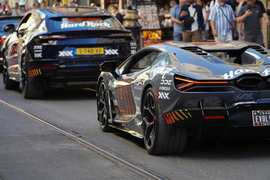
The 21C lineage comprises two distinct iterations. First, the high-downforce 21C—a track monster named to mark the 21st century. And then there’s the VMax, a wingless, long-tailed version that represents the peak of road-legal insanity. I had the privilege of piloting the silver 21C VMax during the inaugural Velocity Tour, a challenging 500-mile road rally through the wine country of Central and Northern California.
The Pilot’s Perspective
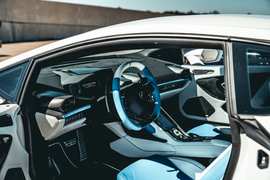
The term “piloting” is deliberate. The cabin of the 21C VMax feels more like a fighter jet canopy than a conventional greenhouse. While I haven’t flown in a jet fighter, I’ve experienced the breathtaking intimacy of a stunt plane. The sensation is remarkably similar: less than a foot of glass separates you from the outside world on both sides.
Exiting and entering this machine is an event in itself. You sit with your legs positioned out on the massive sill, pull your knees up as you spin on your butt, tuck your feet into the footwell, and then slide your head under the roof. It requires flexibility, patience, and perhaps a degree of commitment that aligns with the car’s extreme nature.
One reason these sills are so substantial is what they contain: batteries. The 21C VMax is a hybrid hypercar, with a 4.4-kWh battery pack split between the sills. It’s not a plug-in hybrid; rather, the mid-mounted engine keeps the pack charged. These batteries contribute a massive 500 horsepower to the front axle, which features one motor per wheel. This electric drive system provides instantaneous torque, smoothing out the delivery of the combustion engine.
The heart of the beast is a Czinger-designed 2.9-liter twin-turbo V-8, rated at 750 hp on California’s standard 91-octane premium fuel. For those seeking ultimate performance, 100-octane race fuel boosts horsepower to 850. Czinger has hinted at even greater power potential on ethanol, but those figures remain under wraps, though a 10 percent increase is widely anticipated.
To manage this immense power, the gas engine connects to a Czinger-engineered Xtrac single-clutch automated semi-sequential gearbox. This transmission is structurally similar to the Xtrac seven-speed found in the Pagani Utopia, but Czinger takes it a step further. Not only is the casing 3D printed using their proprietary methods, but they also incorporate small 48-volt electric motors to execute shifts at lower speeds. This ingenious solution eliminates the “drunken surge” that plagues most automated single-clutch transmissions in stop-and-go traffic. The twin-barrel actuators function as advertised, making low-speed maneuvers—like entering gas stations, restaurants, and hotel parking lots—almost manageable. It is a significant technical achievement that deserves commendation.
Track Testing: Testing the Limits of Reality
One aspect of the Velocity Tour that was less than ordinary was having a professional driver alongside me for the first day. Much like Bugatti and Pagani, Czinger insisted on having a safety driver, Evan Jacobs, in the passenger seat to ensure I didn’t pilot the $2.5 million machine into a ditch. Thankfully, Jacobs later confirmed my competence, and I was cleared to drive solo for the remainder of the rally.
We made a stop at Laguna Seca for some parade laps, but non-Czinger employees are restricted from driving the VMax on the track, even at the sedate pace set by the rally participants. I still jumped in the bizarre rear seat to experience the ride. Those with large calves or feet will find the rear seating experience challenging. My XXL calves were essentially wedged between the carbon fiber tub and the seat, and my feet didn’t fit comfortably. However, the visibility through the side glass is astounding. Reminiscent of a stunt plane, it offered a novel way to experience a track—something I’ve done thousands of times.
The highlight came when Jacobs and I convinced the Skip Barber Racing School staff to let him take the VMax for a couple of “6/10ths” hot laps. The most intense hot lap I’ve ever experienced was riding shotgun in an Aston Martin Valkyrie LMH race car, where I could feel blood pooling in my extremities under braking. The Czinger VMax is now second on that list.
Remember, Jacobs wasn’t pushing the car to its limits. Even at reduced speed and without the massive rear wing of the standard 21C, it’s easy to understand how the brand achieved the legendary California Gold Rush feat. This refers to the five production car track records set in five days—at Thunder Hill, Sonoma Raceway, Laguna Seca, Willow Springs, and The Thermal Club—while driving between each location. Later, Czinger returned to Laguna Seca to not only break their own record but to reclaim the throne from the Koenigsegg Jesko Sadair’s Spear. The lap time of a ridiculous 1 minute, 22.30 seconds is faster than the fastest MotoAmerica Superbike lap ever recorded at Laguna (a 1:22.56).
Czinger claims a vehicle weight of approximately 3,600 pounds, which is incredibly light for a 1,250-horsepower hybrid hypercar. For context, the Ferrari SF90 Stradale Asseto Fiorano—the highest-performance version of a three-motor, twin-turbo V-8 PHEV producing 986 hp—weighs 3,839 pounds. The new Lamborghini Temerario, another three-motor twin-turbo V-8 with less power, pushes past two tons, clocking in at a hefty 4,185 pounds.
Considering these benchmarks, the Ferrari SF90 and Lamborghini Temerario are the two quickest gasoline-powered cars MotorTrend has ever tested (the Ferrari for 0–60 mph and the Lambo for the quarter mile). If Czinger’s weight claims prove true, the Southern California startup has managed to outperform two Italian legends with their debut production car. This is remarkable on its own, but particularly noteworthy given that while Los Angeles is famous for many things, there isn’t a deep historical pool of supercar engineering expertise. In other words, L.A. isn’t exactly Modena.
The Road Less Traveled
The route for the Velocity Tour consisted largely of true back roads. These were thetight, winding, treacherous roads that modern hypercars typically avoid. There was also a lot of following the pack, navigating to lunch and coffee stops, and keeping pace with the camera car. I must admit, at the time, I felt a slight sense of disappointment. But in retrospect, the experience gave me a profound understanding of what most owners will likely experience while living with a Czinger.
To my surprise, the VMax was mostly manageable. Take everything out of your pockets before you get in as the seats are tight; drink your water before entry as there are no cupholders; and steel yourself for the fact that almost everyone on the road—especially males between 16 and 24—will be staring, following, waving, and revving.
Regardless of the attention, the Czinger handles significantly better than I anticipated. The team deserves applause for not making it overly stiff. The air conditioning works well, which is a rarity in this class of vehicle.

 Czinger 21C VMax: A 1,250-HP Hybrid That Defies Engineering and Reality
The Southern California Startup’s Hyperscar Represents the Future as Well as Utter Madness in Automotive Form.
When you picture a hypercar from Southern California, you might imagine a fleet of Pagani Huayras or maybe a Ferrari F80 being tested near their Italian parents. But the reality of automotive innovation is shifting, and at the forefront of this seismic change is Czinger Vehicles. This company, rooted in advanced additive manufacturing and AI-driven design, has produced a vehicle that doesn’t just push boundaries—it tears the sheet off the blueprint and redefines what’s possible.
For years, the automotive world has been speculating about Czinger’s contributions. While the company’s parent, Divergent Technologies, is a silent partner in the defense supply chain, its automotive side is anything but quiet. Imagine a company where the line between aerospace engineering and street-legal performance blurs, where every component is “Pareto optimal”—the sweet spot where form and function achieve the perfect, near-unobtainable balance. That is the ethos of Czinger.
Czinger 21C VMax: A 1,250-HP Hybrid That Defies Engineering and Reality
The Southern California Startup’s Hyperscar Represents the Future as Well as Utter Madness in Automotive Form.
When you picture a hypercar from Southern California, you might imagine a fleet of Pagani Huayras or maybe a Ferrari F80 being tested near their Italian parents. But the reality of automotive innovation is shifting, and at the forefront of this seismic change is Czinger Vehicles. This company, rooted in advanced additive manufacturing and AI-driven design, has produced a vehicle that doesn’t just push boundaries—it tears the sheet off the blueprint and redefines what’s possible.
For years, the automotive world has been speculating about Czinger’s contributions. While the company’s parent, Divergent Technologies, is a silent partner in the defense supply chain, its automotive side is anything but quiet. Imagine a company where the line between aerospace engineering and street-legal performance blurs, where every component is “Pareto optimal”—the sweet spot where form and function achieve the perfect, near-unobtainable balance. That is the ethos of Czinger.