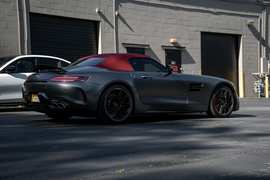
Czinger 21C VMax: A Hypercar of the Future, Drenched in Future-Cool
For years, the world has followed Czinger’s relentless pursuit of the “Pareto optimal”—the absolute peak of engineering where adding or removing even a single gram becomes a liability. Their journey culminated in the Czinger 21C, a hypercar so avant-garde it feels less like a machine and more like a living artifact from a distant, hyper-advanced future. I recently embarked on a three-day journey in the Czinger 21C VMax, a wingless, stretched-tail variant of the 21C, navigating California’s wine country. The idea? To understand what this $2.5 million, 3D-printed, 1,250-horsepower machine feels like when you do more than just stare at it—when you actually live with it.
Factory Fresh: Entering the Digital Assembly Line
My first glimpse into Czinger’s world was less like a factory visit and more like an infiltration of a secure, high-tech research facility. The parent company, Divergent Technologies, operates in a space where automotive engineering meets defense technology, a fact underscored by the necessity of showing a U.S. passport to gain entry—a rare occurrence in the automotive industry. I was guided by Lukas Czinger, the visionary young CEO who, alongside his father Kevin, is steering this enterprise.
Divergent leverages iterative artificial intelligence to design and produce incredibly light, yet astronomically strong, mechanical components. One moment that crystallized this for me was a tour inside one of their massive 3D printers. Gazing at the synchronized dance of lasers fusing powdered aluminum into complex shapes—components that looked eerily biological, like delicate bird bones—I felt a profound sense of displacement. I was witnessing the future of manufacturing, happening right now in Southern California.
Lukas explained that their technology reaches what’s known as the “Pareto optimal.” This isn’t just a buzzword; it’s a rigorous engineering principle where perfection is defined by balance. When engineering a specific component, say, a rear suspension remote reservoir mount, the system faces constraints like space and load tolerance. The software runs hundreds of thousands of iterations, exploring shapes no human engineer would conceive, until it identifies the strongest, lightest configuration. It’s evolution, accelerated to an almost frightening degree. Beyond the military applications, which were discreetly cordoned off but hinted at with military-grade parts that resembled rocket components, nine automotive OEMs rely on Divergent’s printing technology. While Aston Martin, Bugatti, and McLaren openly acknowledge their use of these 3D-printed parts, the structural integrity of the Ferrari F80’s control arms certainly makes Divergent a strong candidate for their supplier, too.
Under the Carbon Fiber: A Hybrid Beast of the Second Order
Czinger produces two primary versions of the 21C. The standard 21C (named for the 21st century) is the high-downforce track monster, while the VMax variant is the wingless, long-tailed grand tourer. For the inaugural Velocity Tour, a 500-mile road rally traversing Northern and Central California’s renowned wine country, I was assigned a silver VMax.
The term “piloting” is used deliberately because the cockpit feels less like a passenger cabin and more like a fighter jet canopy. Czinger has intentionally designed it this way, and the resemblance to aviation is striking. While I hadn’t experienced a closed-cockpit stunt plane before, I had the privilege of riding inside an Extra 330LT, and the similarities were uncanny. You are surrounded by glass less than a foot from your head, offering panoramic visibility that belies the car’s complex engineering.
Getting in and out, however, remains a gloriously ridiculous exercise. You must first position yourself perpendicular to the car, your legs braced on the massive sill. Then comes the delicate maneuver of pulling your knees up and rotating your body like a gymnast—tucking your feet into the narrow footwell, and finally, sliding your head under the carbon fiber roof. It’s a process that demands patience and flexibility.
One reason for these substantial sills is the battery integration. The 21C VMax is a full hybrid, and each sill houses a 2.2-kWh battery pack, totaling 4.4 kWh. Unlike plug-in hybrids, the VMax is a self-charging system where the mid-mounted V8 engine powers a generator to keep the battery topped off. These batteries supply a combined 500 horsepower to the front wheels, each driven by its own independent electric motor. The combustion heart of the machine is a 2.9-liter twin-turbo V-8 engine, designed in-house by Czinger. On California’s standard 91-octane premium, it produces 750 horsepower. However, when filled with 100-octane racing fuel, the output swells to 850 horsepower. The engine is also capable of running on ethanol, which Czinger estimates could yield an additional power boost, though those figures remain closely guarded.
To handle the 1,250 horsepower (when combining gas and electric), the 21C VMax utilizes an Xtrac seven-speed single-clutch automated semi-sequential gearbox. While structurally similar to the Pagani Utopia’s transmission, Czinger’s version adds a layer of 3D-printed ingenuity. They employ small 48-volt electric motors to execute shifts with lightning speed, particularly at lower velocities. This eliminates the “drunken” or surging feeling that plagues traditional automated single-clutch transmissions at low speeds. I was thankful to discover during the rally that these twin-barrel actuators work precisely as advertised, making low-speed maneuvering—navigating gas stations, restaurants, and hotel parking lots—feel surprisingly smooth and almost normal. It’s a testament to the engineering prowess that so much power can be tamed so effectively.
Track Time: The Brutal Physics of Speed
For the inaugural Velocity Tour, a 500-mile road rally through California’s wine country, I found myself piloting a silver VMax. For me, that meant a co-pilot for the first day. As is common practice with many high-dollar hypercars—think Bugatti and Pagani—Czinger assigned a professional driver, Evan Jacobs, to ensure I didn’t become the first person to crash a $2.5 million car. Thankfully, Jacobs later assured the Czinger team I was no threat to the machine, and I was permitted to drive solo for the remainder of the rally.
We made a stop at Laguna Seca for some parade laps, but unfortunately, non-Czinger employees are not permitted to drive the VMax on racetracks, even at the aggressively slow pace limited by the rally participants. However, as I have learned the hard way, even if you cannot drive, always accept the ride—and I scrambled into the bizarre rear seat. The first thing to note is that if you have large calves or feet, the back-seat experience is challenging. My XXL calves were literally wedged between the carbon fiber tub and the seat, and my feet didn’t fit well either. However, the visibility through the side glass is phenomenal. Again, it felt like piloting a jet fighter and was a remarkably novel way to experience a racetrack—an environment I’ve navigated over a thousand times before.
This novel perspective became even more striking when Jacobs and I convinced the Skip Barber Racing School staff to let him take the VMax for a couple of “6/10ths” hot laps. The most impressive hot lap I’ve ever experienced was riding shotgun in an Aston Martin Valkyrie LMH race car, where I could literally feel the blood pooling in my extremities under braking. The Czinger VMax now sits firmly in second place on that list, and remember, Jacobs was nowhere near pushing the car to its limits. Even at that reduced pace, and without the benefit of the large downforce wing found on the track-focused model, it was easy to understand how the standard Czinger 21C achieved what the brand calls the “California Gold Rush.” This achievement saw the car set five production car track records—at Thunder Hill, Sonoma Raceway, Laguna Seca, Willow Springs, and The Thermal Club—in the span of just five days, driving between each venue.
Later, Czinger returned to Laguna Seca to not only beat their own record but to reclaim the crown from the specialized Koenigsegg Jesko Sadair’s Spear. The resulting lap time—a jaw-dropping 1 minute and 22.30 seconds—is faster than the fastest MotoAmerica Superbike lap ever recorded at Laguna, which stands at 1:22.56.
Czinger claims a vehicle weight of approximately 3,600 pounds. For a 1,250-horsepower hybrid hypercar, this is remarkably light. For context, the Ferrari SF90 Stradale Asseto Fiorano—the highest-performance version of a three-motor, twin-turbo V8 PHEV, which produces 986 hp—weighs 3,839 pounds. The new Lamborghini Temerario, another three-motor, twin-turbo V8 (producing less power, but still a valid comparison), pushes well past the two-ton mark, coming in at a chunky 4,185 pounds.
It is worth mentioning that the SF90 and the Temerario hold the records for the quickest gasoline-powered cars MotorTrend has ever tested—the Ferrari for 0-60 mph, and the Lambo for the quarter mile. If Czinger’s

 Czinger 21C VMax: A Hypercar of the Future, Drenched in Future-Cool
For years, the world has followed Czinger’s relentless pursuit of the “Pareto optimal”—the absolute peak of engineering where adding or removing even a single gram becomes a liability. Their journey culminated in the Czinger 21C, a hypercar so avant-garde it feels less like a machine and more like a living artifact from a distant, hyper-advanced future. I recently embarked on a three-day journey in the Czinger 21C VMax, a wingless, stretched-tail variant of the 21C, navigating California’s wine country. The idea? To understand what this $2.5 million, 3D-printed, 1,250-horsepower machine feels like when you do more than just stare at it—when you actually live with it.
Factory Fresh: Entering the Digital Assembly Line
Czinger 21C VMax: A Hypercar of the Future, Drenched in Future-Cool
For years, the world has followed Czinger’s relentless pursuit of the “Pareto optimal”—the absolute peak of engineering where adding or removing even a single gram becomes a liability. Their journey culminated in the Czinger 21C, a hypercar so avant-garde it feels less like a machine and more like a living artifact from a distant, hyper-advanced future. I recently embarked on a three-day journey in the Czinger 21C VMax, a wingless, stretched-tail variant of the 21C, navigating California’s wine country. The idea? To understand what this $2.5 million, 3D-printed, 1,250-horsepower machine feels like when you do more than just stare at it—when you actually live with it.
Factory Fresh: Entering the Digital Assembly Line