Czinger 21C VMax: A Glimpse into the Hypercar Future
For years, the automotive world has buzzed with whispers of Czinger, a Southern California company that seemed to be building machines from science fiction. With its alien-tech aesthetic, center-steer cockpit, and seven-figure price tag, the 21C VMax represented something truly different—an embodiment of future engineering, even if that future verged on pure madness. As a writer who has spent a decade navigating the extremes of performance engineering, I was compelled to experience this avant-garde marvel firsthand. While a track story was expected, the real question was: what is a center-steer, tandem two-seater actually like on a 500-mile road rally?
Factory Fresh: Where Defense Meets Hypercars
My journey into the heart of Czinger’s innovation began not with a red carpet, but with a U.S. passport check. The parent company, Divergent Technologies, operates on a different plane, integrating iterative artificial intelligence and massive 3D printers to create ultra-lightweight yet incredibly strong mechanical components. Divergent’s technology also serves the Department of Defense, which explains the need for official identification. While the military hardware was discreetly shielded during my visit—one piece bore a passing resemblance to a rocket—the tour provided by the young CEO, Lukas Czinger, was nothing short of spectacular. Peering into one of the colossal printers felt like witnessing the genesis of the future, where more than a dozen lasers fused powdered aluminum into forms reminiscent of avian skeletons.
Lukas explained that Divergent’s technology achieves “Pareto optimality,” a point where adding or subtracting a single gram becomes detrimental to performance. Consider the engineering challenge of designing a rear suspension damper reservoir mount. A designer specifies the available space and the required load-bearing capacity, and the software then iterates through hundreds of thousands of designs. This process, akin to evolution on fast-forward, identifies the strongest yet lightest shape possible. Beyond the defense sector, nine automotive OEMs utilize Divergent’s 3D-printed parts. Though not all public, Aston Martin (DBR22 Roadster), Bugatti (Tourbillon), and McLaren (W1) are open about their collaboration, while the Ferrari F80’s control arms certainly look like suspects.
Under the Carbon Fiber: The 21C VMax Revealed
Czinger produces two variants of essentially the same platform. The high-downforce, track-focused 21C, named for the 21st century, is paired with the wingless, long-tailed VMax. Technically the 21C VMax, the “21C” designation is absent from the car’s exterior. For the inaugural Velocity Tour, a 500-mile road rally traversing Central and Northern California’s wine country, I had the privilege of piloting a silver VMax.
The word “piloting” is deliberate. The cabin feels less like a greenhouse and more like a fighter jet canopy. While I haven’t had the opportunity to fly a jet, I’ve experienced a ride in an Extra 330LT stunt plane, and the similarities are striking. Essentially, the glass is less than a foot from your head on both sides. The visibility is exceptional, but the process of entering and exiting the car is anything but conventional. You begin by sitting with your legs extending outward onto the massive sill, then pull your knees up and pivot on your backside, tucking your feet into the footwell before finally sliding your head under the roof.
One reason for the substantial sills is their storage capacity. The 21C VMax is a hybrid hypercar, with each sill containing 2.2 kWh of battery power, totaling 4.4 kWh. This is not a plug-in hybrid; instead, a motor powered by the mid-mounted V-8 engine charges the pack. These batteries can deliver 500 horsepower to the front axle, which features a motor at each wheel. The combustion engine is a Czinger-designed 2.9-liter twin-turbo V-8 producing 750 horsepower on California’s 91-octane premium fuel. Switching to 100-octane race fuel boosts output to 850 hp. The small but mighty engine can also run on ethanol, potentially producing even more power, though Czinger has yet to release those figures. Industry speculation suggests a 10% increase.
The gas engine drives the rear wheels through an Xtrac single-clutch automated semi-sequential gearbox. This is similar to the Xtrac seven-speed used in the Pagani Utopia, but Czinger not only 3D-prints the transmission case but also employs small 48-volt electric motors to smooth out low-speed shifts. This innovation eliminates the disconcerting lurch characteristic of all other automated single-clutch ’boxes. The twin-barrel actuators perform as advertised in slow-speed maneuvers, a welcome development. Navigating gas stations, restaurants, and hotel parking lots felt remarkably normal.
Track Time: A Glimpse of Automotive Revolution
What never felt normal was the driver sitting directly behind me for an entire day. Typical of high-end hypercars like those from Bugatti and Pagani, Czinger assigned a professional driver (Evan Jacobs) to ensure I wouldn’t drive the $2.5 million machine off a cliff. Thankfully, Jacobs later assured the Czinger team that I was not a threat and was cleared to drive solo for the remainder of the rally. We stopped by Laguna Seca for some parade laps, but for reasons unknown, non-Czinger employees are restricted from driving the VMax on racetracks, even at the slow pace permitted during the rally.
As I’ve learned the hard way, even if you can’t drive, you should always take the ride. I squeezed into the bizarre rear seat. The first thing to note is that if you have large calves or feet, the rear seat experience is less than ideal. My XXL calves were wedged between the carbon-fiber tub and the carbon-fiber seat, and my feet fit awkwardly. However, the visibility through the side windows is incredible. It truly felt like a stunt plane, offering a remarkably novel way to experience a racetrack—a venue I have visited more than 1,000 times.
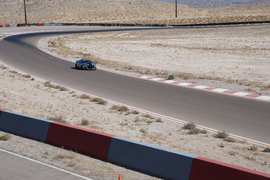
This effect was particularly pronounced when Jacobs and I convinced the Skip Barber Racing School staff (whose track day we crashed) to allow him to take the VMax for a couple of “6/10ths” hot laps. The most extreme hot lap I’ve ever experienced was riding shotgun in an Aston Martin Valkyrie LMH race car, where the braking forces pooled blood in my extremities. The Czinger VMax now ranks second, and remember, Jacobs was holding back. Even at less than full speed and without the high-downforce rear wing, it was easy to understand how a Czinger 21C achieved what the brand calls the California Gold Rush. The VMax set five production car track records—at Thunder Hill, Sonoma Raceway, Laguna Seca, Willow Springs, and the Thermal Club—in just five days, driving between each location. Later, Czinger returned to Laguna Seca to not only beat its own record but reclaim the throne from a track-special Koenigsegg Jesko Sadair’s Spear. The lap time, a blistering 1 minute, 22.30 seconds, is faster than the fastest MotoAmerica Superbike lap ever recorded at Laguna, which stood at 1:22.56.
Czinger claims a vehicle weight of approximately 3,600 pounds, remarkably light for a 1,250-hp hybrid. For context, the Ferrari SF90 Stradale Asseto Fiorano—the highest-performance version of a three-motor twin-turbo V-8 PHEV, generating 986 hp—weighs 3,839 pounds. The new Lamborghini Temerario, another three-motor, twin-turbo V-8 (producing less power but offering a useful comparison), surpasses the two-ton mark, tipping the scales at a hefty 4,185 pounds.
Now is a good time to mention that the SF90 and Temerario are the two quickest gasoline-powered cars MotorTrend has ever tested (the Ferrari for 0–60 mph and the Lamborghini for the quarter mile). If Czinger’s weight claims hold true, this unconventional California startup has managed to surpass two Italian legends right out of the gate. This achievement is remarkable in itself, especially considering that while Southern California is known for many things, there isn’t a deep reservoir of supercar engineering expertise to draw from. In other words, Los Angeles is not exactly Modena.
On the Road: The Reality of Daily Driving
The chosen route for the rally was mostly comprised of actual back roads. Tight, winding, poorly maintained pavement—not the type of asphalt one envisions for a hypercar dream trip. Plus, there was a lot of following the pack, navigating to lunch and coffee stops, and keeping pace with the camera car. While I was perhaps slightly disappointed at the time, in retrospect, what I experienced mirrors what most owners will encounter while living with a Czinger.
To my surprise, the VMax was mostly like driving any other hyper-exotic. Clear your pockets as the seats are snug, drink your water before getting in as there are no cupholders, and come to terms with the fact that almost everyone else on the road, especially males aged 16 to 24, will be staring, following, waving, and revving at you, all while shouting friendly obscenities. Regardless, the Czinger rides better than I anticipated;

 Czinger 21C VMax: A Glimpse into the Hypercar Future
For years, the automotive world has buzzed with whispers of Czinger, a Southern California company that seemed to be building machines from science fiction. With its alien-tech aesthetic, center-steer cockpit, and seven-figure price tag, the 21C VMax represented something truly different—an embodiment of future engineering, even if that future verged on pure madness. As a writer who has spent a decade navigating the extremes of performance engineering, I was compelled to experience this avant-garde marvel firsthand. While a track story was expected, the real question was: what is a center-steer, tandem two-seater actually like on a 500-mile road rally?
Factory Fresh: Where Defense Meets Hypercars
Czinger 21C VMax: A Glimpse into the Hypercar Future
For years, the automotive world has buzzed with whispers of Czinger, a Southern California company that seemed to be building machines from science fiction. With its alien-tech aesthetic, center-steer cockpit, and seven-figure price tag, the 21C VMax represented something truly different—an embodiment of future engineering, even if that future verged on pure madness. As a writer who has spent a decade navigating the extremes of performance engineering, I was compelled to experience this avant-garde marvel firsthand. While a track story was expected, the real question was: what is a center-steer, tandem two-seater actually like on a 500-mile road rally?
Factory Fresh: Where Defense Meets Hypercars