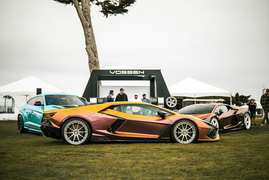
Czinger 21C VMax: The Future of Hypercars Arrives in a Bold, Avant-Garde Package
The hypercar landscape has always been a playground for the brave, the bold, and the frankly unhinged. Brands like Ferrari, Lamborghini, Bugatti, and Koenigsegg have spent decades pushing the boundaries of what’s possible, creating machines that blur the line between art, engineering, and pure performance art. But in recent years, a new player has entered the arena, one that doesn’t just push boundaries—it redraws the map entirely. Meet the Czinger 21C VMax, a car that’s as stunning to look at as it is terrifying to drive, and certainly one of the most captivating vehicles to emerge from the United States in years.
For years, the automotive world has been buzzing about Czinger. Back in the day, even the venerable MotorTrend magazine hosted Kevin and Lukas Czinger, the father-son duo behind this Southern California marvel, on their podcast, The InEVitable. The timing felt perfect: 2026 was shaping up to be a pivotal year for hypercars, and the Czinger was leading the charge, blending cutting-edge technology with radical design. The idea of putting this seven-figure, 1,250-horsepower beast through its paces was too good to pass up. And boy, did it deliver.
Factory Fresh: Welcome to the Future
My journey into the Czinger universe began not with a test drive, but with a factory tour. And let me tell you, I have never had to show my U.S. passport to enter a car factory before—until I visited Czinger.
The parent company, Divergent Technologies, is the true powerhouse behind this innovation. They specialize in using iterative artificial intelligence (AI) and massive 3D printers to engineer incredibly lightweight and strong mechanical components. Why the passport? Because Divergent doesn’t just build hypercars; they supply parts to the Department of Defense (DOD) and various defense contractors. While the military hardware was largely off-limits, I did get a glimpse of something that resembled a rocket—a truly mind-bending sight.
The tour was led by Lukas Czinger himself, the young CEO of both Divergent and Czinger. Seeing one of the massive 3D printers in action was an almost spiritual experience. It felt like witnessing the birth of the future, with lasers zapping powdered aluminum into automotive components that looked like something from a sci-fi movie. It’s simply wild to see the future of manufacturing in the flesh.
Lukas explained that Divergent’s technology strives for “Pareto optimal,” the point where adding or subtracting a single gram becomes a negative. This principle guides their design philosophy. Take, for instance, a simple bracket for a rear suspension damper. An engineer defines the space and the forces it must withstand, and the software iterates through hundreds of thousands of designs to find the strongest, lightest possible shape. It’s evolution on fast-forward. Beyond the DOD, nine major automotive OEMs use Divergent’s 3D-printed parts. Brands like Aston Martin, Bugatti, and McLaren publicly acknowledge their use of the technology, and you can bet even Ferrari has considered it for future models.
Under the Carbon Fiber Hood
Czinger produces two main versions of what is essentially the same car: the Czinger 21C (named after the 21st century), a high-downforce track monster, and the 21C VMax, a long-tailed, wingless version designed for road use and top-speed runs. The 21C badge doesn’t even appear on the car—it’s all VMax.
For the inaugural Velocity Tour, a 500-mile road rally through California’s wine country, I was entrusted with a stunning silver VMax. Why “entrusted”? Because this car feels more like a jet fighter than a traditional vehicle. The cabin is enclosed by glass less than a foot from your head, and the visibility is incredible, much like riding shotgun in an Extra 330LT stunt plane. Getting in is a workout: you sit with your legs facing out on the massive sill, pull your knees up and spin your body while tucking your feet into the footwell, and slide your head under the roof. It’s ridiculous, but it’s also part of the experience.
One reason those side sills are so substantial is that they house the batteries for the hybrid system. The 21C VMax features a 4.4-kWh battery pack, with 2.2 kWh in each sill. This isn’t a plug-in hybrid; instead, a motor powered by the mid-mounted V8 keeps the pack charged. These batteries provide a staggering 500 horsepower to the front axle, which features a dedicated motor per wheel. The mid-mounted, Czinger-designed 2.9-liter twin-turbo V8 is good for 750 hp on California’s 91-octane fuel. Pour in 100-octane race fuel, and the power jumps to 850 hp. Czinger is also experimenting with ethanol, which promises even more power—we’re talking potentially a 10% increase.
The gas engine powers the rear wheels through an Xtrac single-clutch automated semi-sequential gearbox. This transmission is similar to the Xtrac seven-speed found in the Pagani Utopia, but Czinger goes a step further. Not only is the transmission case 3D printed, but they also use small 48-volt electric motors to execute shifts at low speeds. This eliminates the lurching and hesitation that plagues most automated single-clutch gearboxes. The twin-barrel actuators work as advertised, making low-speed driving—pulling into parking lots, navigating tight corners—almost normal. Seriously, it’s impressive.
Track Time: Fast and Furious
For a while, I had a co-driver. Like Bugatti and Pagani, Czinger keeps a pro driver (Evan Jacobs) in the car to ensure the $2.5 million machine doesn’t end up in a ditch. Thankfully, after a few hours, Jacobs assured the Czinger team that I wasn’t a threat and allowed me to drive solo for the rest of the rally.
We stopped by Laguna Seca for some parade laps, but Czinger doesn’t allow non-employees to drive the VMax on track, even at the slow rally pace. So, I got in the back seat. And let me tell you, if you have big calves or feet, the back seat isn’t fun. My XXL calves were wedged between the carbon-fiber tub and the carbon-fiber seat, and my feet didn’t fit well. However, the visibility through the side glass is incredible—like a stunt plane. It’s a novel way to experience a track, even a slow one.
Jacobs convinced the Skip Barber Racing School staff to let him take the VMax for a couple of “6/10ths” hot laps. The most intense hot lap I’ve ever experienced was in an Aston Martin Valkyrie LMH race car, where I could feel my blood pooling in my extremities under braking. The Czinger VMax is now second on my list. Even without going full tilt and without the massive rear wing, it’s easy to understand how a Czinger 21C achieved what the brand calls the California Gold Rush.
This record-setting feat saw the Czinger 21C set five production car track records in five days—at Thunder Hill, Sonoma Raceway, Laguna Seca, Willow Springs, and the Thermal Club—driving from each track to the next. Later, Czinger returned to Laguna Seca to not only beat its own record but to reclaim the throne from a track-special Koenigsegg Jesko Sadair’s Spear. The lap time? A ridiculous 1 minute, 22.30 seconds. That’s faster than the fastest MotoAmerica Superbike lap ever recorded at Laguna, which stands at 1:22.56.
Czinger claims a vehicle weight of approximately 3,600 pounds, which is pretty light for a 1,250-hp hybrid hypercar. For context, the Ferrari SF90 Stradale Asseto Fiorano—the highest-performance version of a three-motor, twin-turbo V8 PHEV with only 986 hp—weighs 3,839 pounds. The new Lamborghini Temerario, another three-motor, twin-turbo V8 (with less power, but you get the comparison), weighs in at a hefty 4,185 pounds.
Now’s a good time to mention that the SF90 and Temerario are the two quickest-accelerating gasoline-powered cars MotorTrend has ever tested (the Ferrari for 0–60 mph and the Lambo for the quarter mile). If Czinger’s weight claim holds true, this unorthodox California startup has managed to beat two Italian legends on its first try. That’s remarkable, especially considering Southern California isn’t known for having a deep pool of supercar building expertise. In other words, L.A. isn’t exactly Modena.
On the Road: The Reality of Driving a Hypercar
The rally route mostly consisted of true back roads: tight, winding, and lousy pavement—not exactly the asphalt hypercar dream trips are made of. Plus, there was a lot of following the pack, navigating to lunch and coffee stops, and keeping up with the camera car. At the time, I was a bit disappointed

 Czinger 21C VMax: The Future of Hypercars Arrives in a Bold, Avant-Garde Package
The hypercar landscape has always been a playground for the brave, the bold, and the frankly unhinged. Brands like Ferrari, Lamborghini, Bugatti, and Koenigsegg have spent decades pushing the boundaries of what’s possible, creating machines that blur the line between art, engineering, and pure performance art. But in recent years, a new player has entered the arena, one that doesn’t just push boundaries—it redraws the map entirely. Meet the Czinger 21C VMax, a car that’s as stunning to look at as it is terrifying to drive, and certainly one of the most captivating vehicles to emerge from the United States in years.
For years, the automotive world has been buzzing about Czinger. Back in the day, even the venerable MotorTrend magazine hosted Kevin and Lukas Czinger, the father-son duo behind this Southern California marvel, on their podcast, The InEVitable. The timing felt perfect: 2026 was shaping up to be a pivotal year for hypercars, and the Czinger was leading the charge, blending cutting-edge technology with radical design. The idea of putting this seven-figure, 1,250-horsepower beast through its paces was too good to pass up. And boy, did it deliver.
Factory Fresh: Welcome to the Future
Czinger 21C VMax: The Future of Hypercars Arrives in a Bold, Avant-Garde Package
The hypercar landscape has always been a playground for the brave, the bold, and the frankly unhinged. Brands like Ferrari, Lamborghini, Bugatti, and Koenigsegg have spent decades pushing the boundaries of what’s possible, creating machines that blur the line between art, engineering, and pure performance art. But in recent years, a new player has entered the arena, one that doesn’t just push boundaries—it redraws the map entirely. Meet the Czinger 21C VMax, a car that’s as stunning to look at as it is terrifying to drive, and certainly one of the most captivating vehicles to emerge from the United States in years.
For years, the automotive world has been buzzing about Czinger. Back in the day, even the venerable MotorTrend magazine hosted Kevin and Lukas Czinger, the father-son duo behind this Southern California marvel, on their podcast, The InEVitable. The timing felt perfect: 2026 was shaping up to be a pivotal year for hypercars, and the Czinger was leading the charge, blending cutting-edge technology with radical design. The idea of putting this seven-figure, 1,250-horsepower beast through its paces was too good to pass up. And boy, did it deliver.
Factory Fresh: Welcome to the Future