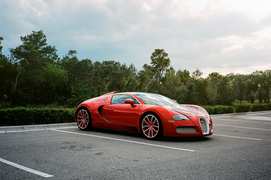
The Czinger 21C VMax: A 3D-Printed Hypercar Pushing the Limits
In the world of hypercars, where performance is king and innovation knows no bounds, one name has recently emerged as a serious disruptor: Czinger. Hailing from Southern California, this revolutionary company has been making waves in the automotive industry, and its latest creation, the Czinger 21C VMax, is a prime example of that paradigm-shifting innovation. In this article, we’ll take a deep dive into what makes the 21C VMax so unique, its exceptional performance, and the revolutionary technology behind it.
3D Printing on a Whole New Level: The Divergent Story
The story of Czinger is intrinsically linked to its parent company, Divergent Technologies. Established with a vision to fundamentally change how vehicles are engineered and built, Divergent leverages cutting-edge artificial intelligence and massive additive manufacturing (3D printing) systems to design and produce incredibly lightweight and strong mechanical components. This revolutionary approach is what sets Czinger cars apart from the competition.
Divergent’s technology has reached a point of “Pareto optimality,” where any further optimization in weight would be detrimental. The company’s engineers utilize AI-driven software to iterate through millions of design variations, creating components that are stronger and lighter than anything achievable through traditional manufacturing methods. This is like accelerating the evolutionary process of a car’s structure. While Divergent supplies 3D-printed parts to a variety of automotive OEMs, only a select few—such as Aston Martin (DBR22 Roadster), Bugatti (Tourbillon), and McLaren (W1)—have publicly acknowledged this partnership. However, it’s strongly suspected that even Ferrari (F80) and others are utilizing this cutting-edge technology. Furthermore, Divergent’s expertise extends to other industries, including the Department of Defense, further validating the robustness and reliability of their additive manufacturing solutions.
The Road to the VMax: Evolution Meets Hypercar Design
Czinger produces two distinct variants of their flagship model: the track-focused 21C and the sleek, long-tailed VMax. The 21C (named after the 21st century) boasts impressive downforce for track performance, while the VMax is designed as a road-legal hypercar with a more streamlined profile. For the inaugural Velocity Tour, a 500-mile road rally through Central and Northern California wine country, the silver VMax was the car of choice.
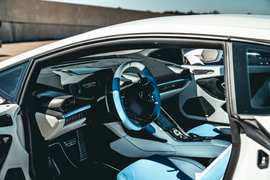
The cabin of the 21C VMax feels more like a fighter jet cockpit than a traditional car interior. With glass positioned inches from both sides of the driver’s head, the visibility is remarkable—a sensation that can be likened to being inside a stunt plane, even for experienced drivers. However, the experience of entering and exiting the vehicle is far from conventional. The sills are massive, requiring the driver to sit with legs extended forward, pull knees up and inward, tuck feet into the footwell, and then slide the head under the roof structure.
Beneath the Surface: Power, Hybrid Technology, and Transmission
The large sills are not just for show; they house the advanced hybrid system that powers the 21C VMax. Each sill contains 2.2 kWh of battery power, totaling 4.4 kWh. This is not a plug-in hybrid system; rather, the batteries are kept charged by the mid-mounted V-8 engine. These electric batteries contribute a substantial 500 horsepower to the front wheels, which are powered by individual electric motors.
The combustion engine is a custom 2.9-liter twin-turbo V-8 designed by Czinger, producing 750 horsepower on California’s 91-octane premium unleaded. When utilizing 100-octane race fuel, the horsepower increases to an astounding 850. The company has also hinted at the engine’s ability to run on ethanol for even greater power output, though official figures are yet to be released. Industry predictions suggest a potential 10 percent increase in horsepower when utilizing this sustainable fuel source.
Power is delivered to the rear wheels through an Xtrac single-clutch automated semi-sequential gearbox. This is similar to the Xtrac transmission used in the Pagani Utopia, but Czinger takes it a step further by not only additively 3D printing the gearbox case but also integrating small 48-volt electric motors to provide faster, smoother shifts at lower speeds. This innovative design eliminates the jarring surges often felt in traditional automated single-clutch transmissions during low-speed maneuvers. The twin-barrel actuators perform flawlessly, making city driving, parking, and navigating gas stations feel almost natural.
Getting Behind the Wheel: A Journey Through California
For the Velocity Tour, a team member was assigned to ride in the rear seat to ensure safety. This is a common practice in high-end hypercars to monitor driving performance. However, after a brief orientation, the Czinger team deemed the driver capable of operating the vehicle solo for the remainder of the rally. Stops were made at Laguna Seca for some parade laps, but non-Czinger employees are not permitted to drive the VMax on the track, even at the slow pace of the tour.
While entering the rear seat was tight due to large calves and feet, the visibility was exceptional, once again reminiscent of a stunt plane. Riding in the back for some parade laps was a unique experience, even for someone who has logged thousands of miles on various racetracks.
When a professional driver had the opportunity to take the VMax for a “6/10ths” hot lap, it was immediately clear how capable this car is. While the Aston Martin Valkyrie LMH race car remains the most extreme passenger experience due to its brutal braking force, the Czinger VMax is a very close second. Even without pushing the VMax to its absolute limit and without the aerodynamic advantage of the rear wing, it was easy to understand how the 21C achieved its “California Gold Rush” accomplishment. The car set five production car track records—at Thunder Hill, Sonoma Raceway, Laguna Seca, Willow Springs, and The Thermal Club—in just five days, driving between each location. Czinger later returned to Laguna Seca to reclaim its record from the track-special Koenigsegg Jesko Sadair’s Spear, completing a lap in a staggering 1 minute, 22.30 seconds. This time beat the fastest MotoAmerica Superbike lap ever recorded at Laguna, which stood at 1:22.56.
Czinger claims a vehicle weight of approximately 3,600 pounds, which is impressive for a 1,250-horsepower hybrid hypercar. For context, the Ferrari SF90 Stradale Asseto Fiorano—a three-motor twin-turbo V-8 PHEV with less power (986 hp)—weighs 3,839 pounds. The Lamborghini Temerario, another three-motor twin-turbo V-8 (also with lower output than the Czinger), weighs a hefty 4,185 pounds. Given these figures, the Czinger has managed to outperform Italian legends in terms of acceleration, despite its unconventional engineering approach. What makes this achievement even more remarkable is that Southern California is known more for tech innovation than supercar manufacturing expertise—L.A. is not exactly Modena.
On the Road: Real-World Performance
The route chosen for the rally primarily consisted of true back roads—tight, winding, and sometimes weathered asphalt, not the pristine surfaces of hypercar dream trips. There were plenty of moments spent following the group, navigating to lunch and coffee stops, and following the camera car. While this might have seemed disappointing at the time, it provided valuable insight into what most owners will experience while driving a Czinger.
To my surprise, the VMax behaved much like a typical hyper-exotic. Drivers need to empty their pockets as the seats are tight, finish drinks before getting in as there are no cupholders, and accept the fact that nearly everyone on the road, especially males aged 16 to 24, will be staring, following, waving, and revving. Despite these common hypercar distractions, the ride comfort of the Czinger is significantly better than expected. The team deserves applause for not making the suspension overly stiff, and the air conditioning works effectively.
My only significant complaint about the road-driving experience is the cabin noise. It’s not the impressive roar of the unique V-8, but rather a noticeable lack of sound deadening. While this might be acceptable in a track-only car like the other 21C variant, it’s an oversight on a road car like the VMax. It becomes particularly annoying after hours of driving. While weight is the enemy of performance, sound-deadening foam isn’t that heavy. Google AI suggests that it weighs between 10 and 50 pounds. A mere 10 pounds of the stuff could significantly improve the driving experience.
The Ultimate Driving Experience
Once we reached the proper canyon roads of California, the Czinger 21C VMax truly came alive. Just as the throttle pedal reached its kickdown point, the next braking zone appeared. The acceleration felt like warp speed—like the car was bending space rather than just rolling over the asphalt. This is the first time I’ve ever admitted this in my career, but I believe this car might be too much for public roads. It’s difficult to say, but every time I engaged the throttle, the braking zone appeared. The VMax is just different. It corners beautifully and offers a phenomenal amount of grip. However, the canyons in Southern California are wider and faster than the ones we drove through

 The Czinger 21C VMax: A 3D-Printed Hypercar Pushing the Limits
In the world of hypercars, where performance is king and innovation knows no bounds, one name has recently emerged as a serious disruptor: Czinger. Hailing from Southern California, this revolutionary company has been making waves in the automotive industry, and its latest creation, the Czinger 21C VMax, is a prime example of that paradigm-shifting innovation. In this article, we’ll take a deep dive into what makes the 21C VMax so unique, its exceptional performance, and the revolutionary technology behind it.
3D Printing on a Whole New Level: The Divergent Story
The story of Czinger is intrinsically linked to its parent company, Divergent Technologies. Established with a vision to fundamentally change how vehicles are engineered and built, Divergent leverages cutting-edge artificial intelligence and massive additive manufacturing (3D printing) systems to design and produce incredibly lightweight and strong mechanical components. This revolutionary approach is what sets Czinger cars apart from the competition.
The Czinger 21C VMax: A 3D-Printed Hypercar Pushing the Limits
In the world of hypercars, where performance is king and innovation knows no bounds, one name has recently emerged as a serious disruptor: Czinger. Hailing from Southern California, this revolutionary company has been making waves in the automotive industry, and its latest creation, the Czinger 21C VMax, is a prime example of that paradigm-shifting innovation. In this article, we’ll take a deep dive into what makes the 21C VMax so unique, its exceptional performance, and the revolutionary technology behind it.
3D Printing on a Whole New Level: The Divergent Story
The story of Czinger is intrinsically linked to its parent company, Divergent Technologies. Established with a vision to fundamentally change how vehicles are engineered and built, Divergent leverages cutting-edge artificial intelligence and massive additive manufacturing (3D printing) systems to design and produce incredibly lightweight and strong mechanical components. This revolutionary approach is what sets Czinger cars apart from the competition.