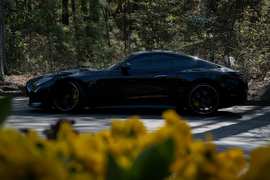
Czinger 21C VMax: The $3 Million Future on a 3-Day Road Rally
For years, the automotive world has been watching Czinger. The Southern California company, founded by father and son Kevin and Lukas Czinger, has been building the kind of hypercar that exists only in dreams. They take the concepts of lightweight 3D-printed chassis, aerospace technology, and alien-grade performance, and smash them together into a seven-figure, 1,250-horsepower machine that bends the laws of physics as we know them.
When I got the chance to drive a Czinger 21C VMax on a three-day road rally—a 500-mile trek through the vineyards of Central and Northern California—I jumped at the opportunity. Yes, there’s a story to be told about the track (more on that later), and everyone is curious about what a 3D-printed, seven-figure hypercar feels like when you push it to the absolute limit. But what’s the experience like when you take this technological marvel out of the carbon-fiber shell and drive it on public roads?
Factory Fresh: More Than Just a Car Factory
I’ve never needed to show my U.S. passport to get into a car factory before. But as you’re about to see, Czinger is just… different. The parent company, Divergent Technologies, uses cutting-edge artificial intelligence and massive 3D printers to design and manufacture incredibly light and strong mechanical components. I needed a government-issued ID because Divergent supplies parts to the Department of Defense, or at least to suppliers for the DOD. Don’t worry, all the military hardware was covered during my visit, but one thing sort of resembled the shape of a rocket.
I was given a tour by Lukas Czinger, the young CEO of both companies, and what I saw was deeply cool. Specifically, a peek inside one of the massive printers made me feel like I was given a glimpse into the future. More than a dozen lasers were zapping powdered aluminum into automotive parts that looked like bird bones. It’s just a wild thing to see.
Lukas explained that Divergent’s tech reaches the “Pareto optimal,” the point after which a single gram, either added or subtracted, becomes a negative. For instance, an engineer might call for a part that holds the remote reservoir for the car’s rear suspension damper. There is X amount of space to fit it, and it needs to withstand forces as strong as Y. Using that target, the software iterates hundreds of thousands of designs until it finds the strongest, lightest shape. It’s a bit like the evolutionary process on fast-forward.
Aside from the DOD, nine automotive OEMs use Divergent as a supplier of 3D-printed parts. Aston Martin (DBR22 Roadster), Bugatti (Tourbillon), and McLaren (W1) are the only three that will publicly cop to it, though the Ferrari F80’s control arms sure look like suspects.
Under the Carbon Fiber: A Jet Fighter on Wheels
Czinger builds two versions of what’s essentially the same car. The high-downforce, track-focused 21C (named after the 21st century) and the wingless, long-tailed VMax. Technically, the latter is the 21C VMax, but the “21C” appears nowhere on the car. For the inaugural Velocity Tour, a 500-mile road rally through Central and Northern California’s wine country, I found myself piloting a silver VMax.
I say “piloting” purposely, as the cabin feels much more like a canopy than a regular vehicular greenhouse. Indeed, Czinger states it’s like being in a jet fighter. I’ve never had the opportunity, but I have gotten a ride inside an Extra 330LT stunt plane, and there’s a similarity. Basically, there’s glass less than a foot away from both sides of your head. The visibility is as excellent as the process of getting in and out of the car is ridiculous: Sit with your legs facing out on the massive sill, pull your knees up and spin on your butt as you tuck your feet into the footwell, then slide your head under the roof.
One reason the sills are so big is because they’re stuffed with batteries. The 21C VMax is a hybrid hypercar, and each sill contains 2.2-kWh worth of battery power (for a 4.4-kWh total). The car isn’t a plug-in hybrid, so a motor powered by the mid-mounted V-8 engine keeps the pack charged. Those batteries can deliver 500 horsepower to the front axle, which has one motor per wheel. The combustion engine is a Czinger-designed 2.9-liter twin-turbo V-8 that’s good for 750 hp on California’s crummy 91-octane premium unleaded. Dump 100-octane race fuel into the tank, and the horsepower increases to 850. The small but mighty engine can also run on ethanol and make even more power, but Czinger hasn’t released those figures; we predict a 10 percent jump.
The gas engine powers the rear wheels via an Xtrac single-clutch automated semi-sequential gearbox. This is like the Xtrac seven-speed Pagani uses on the Utopia, but Czinger not only additively 3D prints the transmission case but also uses small 48-volt electric motors to more quickly execute shifts at lower speeds. This eliminates the drunken, surging feeling all other automated single-clutch ’boxes exhibit at low speeds. The twin-barrel actuators work as advertised in low-speed situations, as I was thankful to discover. Pulling into gas stations, restaurants, and hotel parking lots felt almost normal. Seriously, bravo.
Track Time: The Sound of Speed
What never felt normal was the dude sitting behind me for an entire day. As is typical practice with certain big-dollar hypercars (Bugatti and Pagani), Czinger stuck a pro driver (Evan Jacobs) in the car to make sure I didn’t drive the $2,500,000 thing off a cliff. Thankfully, later that night, Jacobs assured the Czinger team I was no threat to the car and was able to drive solo for the rest of the rally.
We stopped by Laguna Seca for some parade laps, but for whatever reason, non-Czinger employees aren’t allowed to drive the VMax on racetracks, even at the brutally slow pace the rally participants were limited to. As I have learned the hard way, even if you can’t drive, go for the ride, and I scrambled into the bizarre rear seat. The first thing to know here is that if you have big calves or feet, the back-seat experience isn’t great. My XXL calves were literally wedged between the carbon-fiber tub and the carbon-fiber seat, and my feet didn’t fit well, either. However, the visibility through the side glass is incredible. Again, it reminded me of a stunt plane and was a notably novel way to experience riding around a track—something I’ve done more than 1,000 times.
This was especially true when Jacobs and I convinced the Skip Barber Racing School staff (whose track day we crashed) to let him take the VMax for a couple of “6/10ths” hot laps. The most impressive hot lap I’ve ever experienced was riding shotgun in an Aston Martin Valkyrie LMH race car, during which I could feel the blood pooling in my extremities under braking. The Czinger VMax is now second, and remember, Jacobs didn’t go full tilt. Even at something less than the limit and without the big-downforce rear wing, it was easy to understand how a Czinger 21C pulled off what the brand calls the California Gold Rush. That means it set five production car track records—at Thunder Hill, Sonoma Raceway, Laguna Seca, Willow Springs, and the Thermal Club—in five days and drove from each track to the next.
Later on, Czinger returned to Laguna Seca to not only beat its own record, but to reclaim the throne from a track-special Koenigsegg Jesko Sadair’s Spear. That lap time, a ridiculous 1 minute, 22.30 seconds, is quicker than the fastest MotoAmerica Superbike lap ever recorded at Laguna, a 1:22.56.
Czinger claims a vehicle weight of approximately 3,600 pounds, pretty light for a 1,250-hp hybrid vehicle. To give you a bit of context, the Ferrari SF90 Stradale Asseto Fiorano—the highest-performance version of a three-motor twin-turbo V-8 PHEV that only makes 986 hp—weighs 3,839 pounds. The new Lamborghini Temerario is another three-motor, twin-turbo V-8 (that again makes less power, but you get the comparison) that pushes past the two-ton mark, coming in at 4,185 chunky pounds.
Now’s a good time to mention the SF90 and Temerario are the two quickest-accelerating gasoline-powered cars MotorTrend has ever tested (the Ferrari for 0–60 mph and the Lambo for the quarter mile). If Czinger’s weight claim turns out to be true, the unorthodox California startup has managed to beat two Italian legends with job one. That’s remarkable on its own but especially noteworthy

 Czinger 21C VMax: The $3 Million Future on a 3-Day Road Rally
For years, the automotive world has been watching Czinger. The Southern California company, founded by father and son Kevin and Lukas Czinger, has been building the kind of hypercar that exists only in dreams. They take the concepts of lightweight 3D-printed chassis, aerospace technology, and alien-grade performance, and smash them together into a seven-figure, 1,250-horsepower machine that bends the laws of physics as we know them.
When I got the chance to drive a Czinger 21C VMax on a three-day road rally—a 500-mile trek through the vineyards of Central and Northern California—I jumped at the opportunity. Yes, there’s a story to be told about the track (more on that later), and everyone is curious about what a 3D-printed, seven-figure hypercar feels like when you push it to the absolute limit. But what’s the experience like when you take this technological marvel out of the carbon-fiber shell and drive it on public roads?
Czinger 21C VMax: The $3 Million Future on a 3-Day Road Rally
For years, the automotive world has been watching Czinger. The Southern California company, founded by father and son Kevin and Lukas Czinger, has been building the kind of hypercar that exists only in dreams. They take the concepts of lightweight 3D-printed chassis, aerospace technology, and alien-grade performance, and smash them together into a seven-figure, 1,250-horsepower machine that bends the laws of physics as we know them.
When I got the chance to drive a Czinger 21C VMax on a three-day road rally—a 500-mile trek through the vineyards of Central and Northern California—I jumped at the opportunity. Yes, there’s a story to be told about the track (more on that later), and everyone is curious about what a 3D-printed, seven-figure hypercar feels like when you push it to the absolute limit. But what’s the experience like when you take this technological marvel out of the carbon-fiber shell and drive it on public roads?