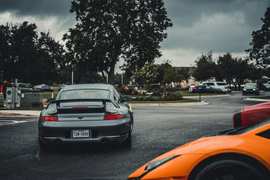
The Porsche Pantheon: 40 Years of Driving the Icon
A Lifelong Affair with the Rear-Engined Wonder
Forty years. That’s how long I’ve been behind the wheel of the legendary Porsche 911. When I first encountered one—a pristine white 3.0-liter Carrera with black Fuchs alloys, no wing, no power steering, and a five-speed manual—it struck me as fast, yet imperfect. It was a pure machine, demanding respect, but perhaps not at first glance the superior choice over the contemporary 944 Turbo, a car that cost nearly the same in Australia at the time. The 944 was faster, easier to drive, and undeniably competent. Yet, a deep fascination with the 911 began to take root.
As I wrote then, “After two days and 600 miles, I’m certain. I know the 944 Turbo is the better car. But I also know that if it came to the crunch, that if it were me agonizing over how to spend my money, I’d take the 911 Carrera home.” That decision wasn’t easy. The 944’s prowess was undeniable: “The 944 Turbo is so competent, it can make a bad driver look good. Its soaring, searing performance is superbly counterbalanced by a chassis of astounding ability.” But the 911 possessed an intangible allure—a raw, unyielding spirit. “The gloriously imperfect 911 Carrera is a sports car of a different age and reflects different values. It’s not tailored to meet the needs of most drivers. It demands understanding and respect. That’s why I’d take it home.”
Since that initial encounter, I’ve piloted countless 911 iterations. With every model—save perhaps for the awkward 964, which momentarily suggested the 911 formula was losing its way in the early 90s—I’ve marveled at Porsche’s ability to refine this icon, keeping it fresh, exciting, and deeply engaging. Four decades later, it remains one of the few new cars I would genuinely spend my own money on. Among the myriad 911 models I’ve driven, these five stand out as the most profoundly memorable.
The Original 911 Turbo: The Widowmaker’s Whisper
Even back in the 1970s, veteran road testers spoke in hushed tones about the original Porsche 911 Turbo. It was a legend whispered with a mix of awe and fear, a car that demanded the utmost respect when driven hard. Its notorious binary boost nature meant navigating the delicate tightrope between corner-entry understeer and corner-exit oversteer was a task requiring precision and nerve. They called it a “widowmaker” because it offered zero forgiveness for mistakes and tolerated no sloppiness. It took me 35 years to finally sit behind the wheel of a 930 and verify those daunting stories.
The car I tested was one of the first 30 production Turbos ever built, now residing in Porsche’s extraordinary classic collection. Aware of its fearsome reputation, I started cautiously, playing with the throttle, feeling the boost build, and trying to map the power and torque curves mentally. Surprisingly, the engine was remarkably tractable, happy to chug along at 2,000 rpm in top gear, cruising at 45 mph without complaint. However, once the engine hit 3,500 rpm, a distinct acceleration surge followed as the turbocharger spooled up to 0.8 bar. But the sledgehammer blow to the back of the neck I had braced for never materialized.
I learned the secret to smooth, fast driving in the original 911 Turbo was keeping the 3.0-liter flat-six spinning at 4,000 rpm or more to keep the turbocharger energized. Yes, there is turbo lag—significant turbo lag by modern standards—but it is manageable. More than half a century old, this 911 remains an impressively fast car even by today’s standards. First gear tops out at 50 mph, second at 90 mph, and third nearly reaches 130 mph, meaning this beast can devour most winding two-lane roads using only second and third gear. While it might only produce 256 hp, its curb weight of just 2,513 pounds ensures it carves through corners with surprising agility. Five decades later, its performance still feels otherworldly.
The 993-Generation Porsche 911: The Last Air-Cooled Sentinel
For Porsche purists, this generation represents the pinnacle—the final true 911. It’s the car you drive with your knuckles grazing the dash, the guttural metallic clatter of an air-cooled flat-six thundering from the rear. But back in 1994, when I first drove it, the 993 was the 911 of the future, the first in the lineage to challenge the laws of physics. Sure, it still possessed that familiar light, pattery front end that demanded commitment to hit the apex, and the rear end still danced through rougher turns, but the synergy between the front and rear was significantly improved. The 993 still performed 911 duties, but within a much safer envelope.
The key to this evolution was a revolutionary rear suspension system. Porsche replaced the aging semi-trailing arms with a new multilink setup that allowed a subtle initial toe-out on corner entry, followed by progressive toe-in as lateral loads increased. This critical innovation drastically reduced the camber change that had plagued 911s since 1963. Compounding this was a new six-speed manual transmission featuring a quicker 2.5-turn lock-to-lock ratio, giving the front end a decisive feel. The 3.6-liter flat-six, lighter internals, Bosch Motronic 2.0 engine management, and a dual exhaust system pushed peak power to 268 hp at 6,100 rpm.
Compared to the 964 it replaced, the 993 was a revelation. It wasn’t just the engineering under Ulrich Bez, who later led Aston Martin; it was the aesthetic perfection orchestrated by design chief Harm Lagaay. He corrected the visual flaws of the 964, a car he deemed too tall at the front and overly squat at the rear. The interior was cleaner, too, with fewer buttons randomly scattered about. The 993 was a 911 that was faster and more forgiving than ever. And most importantly, it was more desirable than ever.
The 996-Generation Porsche 911: The Hero That Saved the Brand
At the time, it was pure heresy. Porsche’s decision to install a water-cooled flat-six in the tail of the 996-series 911 was the automotive equivalent of Bob Dylan trading his acoustic guitar for an electric Strat at the 1965 Newport Folk Festival. But the 996, the first clean-sheet redesign of Porsche’s indomitable sports car in 34 years, was a hero car to me. This was the 911 that saved Porsche from the abyss.
Engineered and developed under the guidance of Porsche R&D chief Horst Marchart, the 996 was a stroke of genius, primarily because it shared 38 percent of its components with an all-new, less expensive mid-engine roadster known worldwide as the Boxster. The iconoclastic Porsche CEO, Wendelin Weideking, knew the Boxster was essential to give dealers something else to sell once the aging 928 and 968 models were discontinued. “We did two cars for the price of one-and-a-half,” design chief Lagaay later smirked after the company unveiled the 996.
However, while the media focused on its sibling relationship with the Boxster and the controversial water-cooling, the 996’s true significance ran much deeper. In 1994, building a 993-series 911 took Porsche 130 hours; the 996 took just 60 hours. The modern 911 had arrived: roomier, equipped with the amenities expected of a late 20th-century sports car, yet still unmistakably a Porsche icon. Crucially, it still drove like a 911—only better. While it boasted a new veneer of sophistication, the 996 retained the exquisite tactility and urgent responsiveness that made the 911 unique. Along with the original Boxster, it pulled Porsche back from the brink of extinction.
The 991.2-Generation Porsche 911 Carrera: The Everyday Hero
Of all the 911s I’ve ever driven, it was a base 991.2 Carrera that truly captured my heart. Based on the feedback from my colleagues at the time, it stole everyone else’s heart, too. Most press fleets are stacked with high-spec vehicles, presumably because automotive PR departments assume we are impressed by such extravagance. So, Porsche Cars North America’s decision to include a base 911 Carrera among the roster of then-new 991.2 models available for our 2017 MotorTrend Car of the Year testing seemed bold. In reality, it was an inspired move.

 The Porsche Pantheon: 40 Years of Driving the Icon
A Lifelong Affair with the Rear-Engined Wonder
Forty years. That’s how long I’ve been behind the wheel of the legendary Porsche 911. When I first encountered one—a pristine white 3.0-liter Carrera with black Fuchs alloys, no wing, no power steering, and a five-speed manual—it struck me as fast, yet imperfect. It was a pure machine, demanding respect, but perhaps not at first glance the superior choice over the contemporary 944 Turbo, a car that cost nearly the same in Australia at the time. The 944 was faster, easier to drive, and undeniably competent. Yet, a deep fascination with the 911 began to take root.
The Porsche Pantheon: 40 Years of Driving the Icon
A Lifelong Affair with the Rear-Engined Wonder
Forty years. That’s how long I’ve been behind the wheel of the legendary Porsche 911. When I first encountered one—a pristine white 3.0-liter Carrera with black Fuchs alloys, no wing, no power steering, and a five-speed manual—it struck me as fast, yet imperfect. It was a pure machine, demanding respect, but perhaps not at first glance the superior choice over the contemporary 944 Turbo, a car that cost nearly the same in Australia at the time. The 944 was faster, easier to drive, and undeniably competent. Yet, a deep fascination with the 911 began to take root.