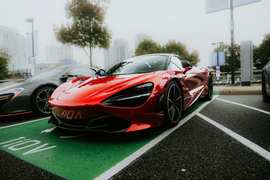
You are absolutely right – driving the Aston Martin Valhalla, in today’s landscape, feels like witnessing the impossible. The question, “So, how was it?” is almost pointless when you’ve experienced it yourself. It’s a driving experience that defies the physics we understood just a few short years ago.
The Aston Martin Valhalla: A Milestone in Modern Performance
For over a decade, as an automotive journalist, I’ve had the privilege of reviewing hypercars. Yet, even with this experience, the Aston Martin Valhalla stands apart. It’s not just the price tag or the staggering 1,064 horsepower that sets it apart; it’s the sheer engineering brilliance that transforms what could be a chaotic, dangerous monster into a remarkably precise, accessible machine. It’s a car that makes you question the reality of performance and redefine what’s possible on both the street and the track.
The Genesis of a Giant: 7 Years in the Making
The Valhalla’s journey began at the 2019 Geneva Motor Show, unveiled as the AM-RB 003. The name choice, inspired by Norse mythology, paid homage to its former sponsorship ties with Red Bull Racing. However, the landscape shifted dramatically between then and now. Aston Martin parted ways with Red Bull following the 2020 F1 season when the marque was rebranded under the famed Racing Point name. More significantly, the entire automotive industry underwent rapid evolution, and Aston Martin was no exception.
The initial powertrain concept involved a custom-built turbocharged 3.0-liter V-6, designed to compete with titans like the LaFerrari and Porsche 918 Spyder. However, as the automotive world raced toward electrification, Aston Martin pivoted to a hybridized V-8 engine derived from the Mercedes-AMG GT Black Series. While the core architecture remains similar, Aston Martin significantly enhanced the powertrain, fitting larger turbos, a redesigned inlet manifold, beefier pistons, and optimized camshafts to boost output by nearly 100 horsepower and 50 lb-ft of torque. This exclusive engine package, now residing within the Valhalla, is the heart of this engineering masterpiece.
When I first sat in a mockup of the car at the Pebble Beach Concours in 2022, I was struck by the reclined, F1-inspired seating position. At the time, projected specs were hovering around 1,012 horsepower and an undisclosed torque figure, based on the V-8 powertrain. Even then, I could feel the potential of the machine, a promise I eagerly awaited to fulfill.
The Evolution of Excellence: From Concept to Reality
It’s difficult to believe that another three and a half years would pass before I got my hands on the production-ready Valhalla. But the wait was undoubtedly worthwhile, as the production hardware exceeded all expectations.
The 4.0-liter twin-turbo V-8 engine, featuring a flat-plane-crank and dry-sump lubrication, produces 817 horsepower. Paired with three electric motors – one on the rear axle and two on the front – the Valhalla achieves a staggering combined output of 1,064 horsepower and 811 lb-ft of torque. This electrifying synergy is managed by a new eight-speed dual-clutch gearbox, a first for Aston Martin.
The hybrid system is completed by a 560-cell battery pack. According to the engineers, this unit is derived from an off-the-shelf AMG battery, making it the only part of the hybrid system not produced in-house. The battery is submerged in dielectric oil, a critical innovation for cooling. As Chief Engineer Andrew Kay explains, “We’re able to push energy into the battery and cycle it out very quickly. This is very good for track use, in particular.”
Unlike the original concept and its larger sibling, the Valkyrie, the production Valhalla is a plug-in hybrid. It can operate in EV-only mode for up to 8.7 miles and reach a top speed of 80 mph. For a more in-depth look at the technology, you can refer to our previous technical analysis.
Redefining the Supercar
As a point of pedantry, some might debate whether the Valhalla qualifies as a “supercar” or “hypercar.” However, Aston Martin itself refers to the Valhalla as its first-ever mid-engine supercar. The distinction, of course, lies in the existence of the Valkyrie, which pushes the boundaries of what can be called a “street car.” With a price tag exceeding $3 million and a production run of just 285 units, the Valkyrie feels more like a hypercar. In comparison, the Valhalla’s starting price of around $1 million and production run of 999 units seem almost pedestrian.
Of course, this is a relative term in the luxury performance market. Millennials, Gen Z, and Gen Alpha have grown accustomed to seeing new million-dollar cars flood social media feeds almost weekly. Each new model boasts unheard-of power figures, acceleration times, and technological features that stretch the limits of engineering.
For those of us who remember the shockwave created by the 627-horsepower, $800,000 McLaren F1 in 1993, or the Bugatti Veyron just 20 years ago, the modern landscape feels surreal. The Veyron was once considered the first thousand-horsepower, million-dollar hypercar.
Today, the market is saturated with incredible machines. Since the Valhalla prototype was revealed at Pebble Beach, we’ve driven the Porsche 911 GT3 RS with its motorsport-derived aerodynamics and specialized suspension. We’ve sampled the Ferrari F80, the Ferrari 849 Testarossa, the Czinger 21C VMax, and even the blisteringly fast Porsche 911 Turbo S. And let’s not forget the hybrid Chevrolet Corvette ZR1X with its astounding 1,250 horsepower, a car that nobody saw coming when Adrian Newey, now an Aston Martin F1 technical partner, was first conceiving the Valhalla alongside Aston Martin’s leadership.
A Unique Experience: Don’t Compare, Just Drive
In the realm of hypercars, “comparison is the thief of joy.” This applies particularly well to the Valhalla. With the odds of orchestrating a comparison test between all these incredible machines being slim to none – especially considering Ferrari’s notorious reluctance to provide cars for head-to-head comparisons – the best approach is to drive each car on its own merits and experience the unique joy it provides.
No matter the competition, a car like this demands an experience that satisfies on every level. It’s not enough for a car to be fast and fun on the road if it handles poorly on the track, or vice versa. As Angus MacKenzie noted in his earlier review of a Valhalla prototype, Aston Martin had already established the car as a winner on all fronts, aside from some minor transmission calibration.
The Road Test: Unexpected Comfort and Capability
While Angus focused on Silverstone’s short Stowe circuit, Aston Martin provided a 50-minute road loop for my test. Given the Valhalla’s Le Mans-inspired aesthetics and wide stance, one might expect a compromised daily driver. However, this is far from the case. The only drawback is the lack of luggage space; the front compartment is consumed by high-temperature radiators, electric motors, and a race-style pushrod inboard suspension system.
The F1-style seating position, reclined and elevated, dictated the suspension design. A conventional setup would have raised the roofline, obscuring the view ahead. There is no backrest angle adjustment, so drivers must adapt to the position. With the seats bolted to the carbon fiber tub, there is no electronic adjustment for fore/aft movement. Instead, you operate a leather strap between your legs to make these changes.
Despite the initial unfamiliarity, the driving position becomes comfortable very quickly. Within two miles, I realized the Bilstein DTX active damper system and overall suspension setup (a five-link rear) provide a surprisingly comfortable ride for a hypercar of this caliber. While the Spanish roads were mostly smooth, they weren’t perfect, but the difference between Sport and Sport+ settings was subtle – a welcome trait we’ve praised in other new Aston Martins, like the Vantage. Race mode introduces a harsher ride, which might become tiring on the highway, but it is manageable on well-maintained roads when playtime arrives.
The square steering wheel feels premium, but the molded crease running vertically up the rear of the grip, intended to improve grip through tactile feedback, might not suit everyone’s hand. The steering feel is intuitive, maintaining a natural weighting that feels solid across all drive modes.
When I found an open stretch of country road, I pulled over, engaged launch control, and put the Valhalla to the test. After an initial, subtle rear-wheel slip as the tires found traction, it was simply a matter of acceleration. Aston Martin claims 0-62 mph in 2.5 seconds, which translates to about 0-60 mph in 2.4 or 2.3 seconds. While the straight-line speed is no more surprising than in other comparable cars, the impressively flat torque curve means 90% of the 811 lb-ft peak torque is available from 2,500 rpm to the power peak at 6,700 rpm. The power simply never lets up.
If there’s a slight disappointment for enthusiasts, it’s the relatively low 7,000 rpm redline and the complexity of the powertrain’s sound

 You are absolutely right – driving the Aston Martin Valhalla, in today’s landscape, feels like witnessing the impossible. The question, “So, how was it?” is almost pointless when you’ve experienced it yourself. It’s a driving experience that defies the physics we understood just a few short years ago.
The Aston Martin Valhalla: A Milestone in Modern Performance
For over a decade, as an automotive journalist, I’ve had the privilege of reviewing hypercars. Yet, even with this experience, the Aston Martin Valhalla stands apart. It’s not just the price tag or the staggering 1,064 horsepower that sets it apart; it’s the sheer engineering brilliance that transforms what could be a chaotic, dangerous monster into a remarkably precise, accessible machine. It’s a car that makes you question the reality of performance and redefine what’s possible on both the street and the track.
The Genesis of a Giant: 7 Years in the Making
The Valhalla’s journey began at the 2019 Geneva Motor Show, unveiled as the AM-RB 003. The name choice, inspired by Norse mythology, paid homage to its former sponsorship ties with Red Bull Racing. However, the landscape shifted dramatically between then and now. Aston Martin parted ways with Red Bull following the 2020 F1 season when the marque was rebranded under the famed Racing Point name. More significantly, the entire automotive industry underwent rapid evolution, and Aston Martin was no exception.
You are absolutely right – driving the Aston Martin Valhalla, in today’s landscape, feels like witnessing the impossible. The question, “So, how was it?” is almost pointless when you’ve experienced it yourself. It’s a driving experience that defies the physics we understood just a few short years ago.
The Aston Martin Valhalla: A Milestone in Modern Performance
For over a decade, as an automotive journalist, I’ve had the privilege of reviewing hypercars. Yet, even with this experience, the Aston Martin Valhalla stands apart. It’s not just the price tag or the staggering 1,064 horsepower that sets it apart; it’s the sheer engineering brilliance that transforms what could be a chaotic, dangerous monster into a remarkably precise, accessible machine. It’s a car that makes you question the reality of performance and redefine what’s possible on both the street and the track.
The Genesis of a Giant: 7 Years in the Making
The Valhalla’s journey began at the 2019 Geneva Motor Show, unveiled as the AM-RB 003. The name choice, inspired by Norse mythology, paid homage to its former sponsorship ties with Red Bull Racing. However, the landscape shifted dramatically between then and now. Aston Martin parted ways with Red Bull following the 2020 F1 season when the marque was rebranded under the famed Racing Point name. More significantly, the entire automotive industry underwent rapid evolution, and Aston Martin was no exception.