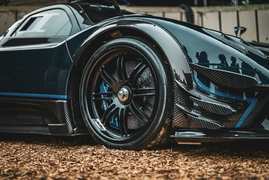
Aston Martin Valhalla: A New Era of Hypercar Dominance in 2025
For decades, the term “supercar” conjured images of low-slung Italian exotica, exotic materials, and ear-splitting exhaust notes. But today, the landscape has shifted dramatically. In 2025, the boundaries between hypercars and supercars are blurrier than ever, and the Aston Martin Valhalla sits squarely at the epicenter of this thrilling, high-stakes revolution. This is not your grandfather’s supercar; it’s a futuristic missile that redefines the limits of what’s possible on the street and the track.
The Long Road to Valhalla
It feels like a lifetime ago that Aston Martin first unveiled the AM-RB 003 concept at the 2019 Geneva Motor Show. Named after the Norse mythology realm of the heroic dead, the car promised a blend of extreme performance and lightweight engineering inspired by Aston’s Formula 1 ties with Red Bull Racing. Seven years (and several mind-bending pandemic years later) have passed, and the world of high-performance motoring has undergone a seismic shift.
Back then, the original concept featured an in-house-designed turbocharged 3.0-liter V-6, but the automotive landscape evolved rapidly. Aston and Red Bull eventually parted ways, and the Valhalla’s powertrain was reimagined. Now, it’s powered by a hybridized Mercedes-AMG GT Black Series-derived twin-turbo V-8. While it retains Aston’s signature DNA, the collaboration with AMG has resulted in a more potent, race-ready machine.
When the 2026 Aston Martin Valhalla was showcased at the Pebble Beach Concours, the projected specs had already ballooned to 1,012 hp. Yet, the production model would exceed even those ambitious numbers. For anyone who has been fortunate enough to experience the state-of-the-art of 2025 performance cars, the Valhalla feels less like an evolution and more like a quantum leap.
Breaking the Rules: A Hybrid Masterpiece
The defining feature of the Aston Martin Valhalla is its revolutionary hybrid powertrain. This isn’t just about combining electric motors with a gas engine; it’s a masterclass in engineering precision designed for track day performance and hypercar dynamics.
The heart of the Valhalla is a flat-plane-crank, dry-sump, twin-turbo 4.0-liter V-8 producing a staggering 817 hp. This is paired with 248 hp from three Aston-designed radial-flux permanent-magnet motors. One is mounted on the front axle, while the other two work in concert with a new eight-speed dual-clutch gearbox, marking Aston Martin’s first foray into this revolutionary transmission technology.
The result? A jaw-dropping total output of 1,064 hp and 811 lb-ft of torque. But the magic doesn’t stop there. The Valhalla features a 560-cell battery pack, utilizing off-the-shelf AMG technology that’s immersed in dielectric oil. This unique cooling solution allows for incredibly rapid charging and deployment of electrical energy, making it the ideal choice for motorsport enthusiasts and track-focused drivers.
Unlike its hypercar sibling, the Valkyrie, the Valhalla is also a plug-in hybrid. It can travel up to 8.7 miles in EV-only mode, offering a surprising degree of versatility for a car of this caliber.
The Price of Extremity: Is the Valhalla a Hypercar?
There’s a persistent debate about whether the Valhalla should be called a “supercar” or a “hypercar.” Aston Martin officially refers to it as its first-ever mid-engine supercar, but the existence of the Valkyrie—a hypercar priced at over $3 million—forces a marketing distinction.
However, if we look at the raw numbers and 2025 market trends, the Valhalla ($1 million MSRP, 999-unit production run) feels almost pedestrian compared to its hypercar cousins. This paradox speaks volumes about the current state of high-performance automotive engineering.
For younger generations accustomed to seeing luxury sports cars with dizzying power figures, the Valhalla might not seem as shocking as, say, the McLaren F1 did in 1993 or the Bugatti Veyron did two decades ago. Today, the hybrid hypercar market is flooded with insane technology. Just since the Valhalla was first revealed, we’ve driven the Porsche 911 GT3 RS, the Ferrari F80, and the Czinger 21C VMax, all of which push the boundaries of performance driving.
Then there’s the Corvette ZR1X, a hybrid powerhouse with 1,250 hp that no one predicted when the Valhalla was merely a concept in the minds of Adrian Newey and Aston Martin’s engineers.
A Different Kind of Thrill: Driving the Valhalla
In the world of modern high-performance cars, comparison is often the thief of joy. The Valhalla exists at the zenith of engineering, where the dynamic limits are so high that trying to compare it to lesser cars feels trivial. Instead, it’s best enjoyed on its own merits, providing an experience that is both thrilling and sublime.
As Angus MacKenzie previously noted after his first drive, the Valhalla feels deceptively easy to handle, much like a Vantage. He correctly suspected that the car’s performance would translate to faster, more flowing circuits, and he was right. The Valhalla remains stable and planted, no matter what you throw at it.
For those seeking a dramatic, sideways circus, the Valhalla might be too composed. However, for enthusiasts who appreciate the latest Aston Martin technology and track-ready handling, this is the car that redefines the segment. The front-axle torque vectoring and e-differential work tirelessly to keep the chassis rotating with precision, encouraging drivers to push harder with unshakable confidence.
The Road to Performance: Comfort and Capability
Despite its extreme performance, the 2025 Aston Martin Valhalla is surprisingly comfortable for a mid-engine supercar. Unlike many of its rivals, which compromise daily usability for track performance, the Valhalla strikes a near-perfect balance.
At least, aside from the utter lack of luggage space. Three high-temp radiators, electric motors, and a racing-style pushrod suspension eat up any potential cargo room. The F1-style seating position is extreme—you sit low with your legs elevated—and there’s no power adjustment. Instead, you pull a leather strap between your legs to move the seat forward or back.
While this might sound daunting, you adapt quickly. The Valhalla-specific Bilstein DTX active dampers and overall suspension setup provide a comfortable ride that belies its performance credentials. The Spanish road route we drove wasn’t perfectly smooth, but the suspension handled it with grace. There’s a sweet spot between the Sport and Sport+ settings that Aston Martin has perfected, offering usable performance without the bone-jarring harshness of a dedicated race car.
The square-ish steering wheel feels nice in the hands, although the molded crease might not be comfortable for everyone. The steering feel itself is intuitive, maintaining a perfect weight that never feels too heavy or too light across different drive modes.
When I found a long, empty stretch of country road, I unleashed the Valhalla’s full potential. Launching the car as hard as possible yielded a slight wiggle from the rear before the tires hooked up and the acceleration became relentless. Aston claims 0–62 mph in 2.5 seconds, so expect a 0–60 time of around 2.3–2.4 seconds. The speed is staggering, but what’s truly remarkable is the torque curve. 90% of the peak 811 lb-ft of torque is available from 2,500 rpm to 6,700 rpm. It simply doesn’t let up.
One minor disappointment for enthusiasts might be the redline of 7,000 rpm. Combined with a symphony of electric motors, turbos, and induction, the engine note is satisfying without being overwhelmingly loud. However, it won’t make any “greatest-sounding engines” lists. There’s just a lot going on, and sometimes, the noise doesn’t elevate the experience.
Precision on the Track: The Navarra Circuit Experience
The real heart of the 2025 Aston Martin Valhalla beats on the track. At Spain’s Circuito de Navarra, this supercar transforms into a precision weapon. The trick torque vectoring, aerodynamics, and monster braking system shine in this closed environment.
You want to run the Valhalla in Race mode, not just because of the name, but because of the unique hybrid system. In Sport+ on the road, the car dumps massive electric boost to the wheels, draining the battery quickly as drivers demand full power in short bursts. The brake-by-wire system then recovers the energy, preparing the car for the next acceleration.
On the track, where full power is demanded constantly, Race mode employs a recharge strategy that keeps up to 15% state of charge. This prevents the battery from ever fully depleting, ensuring consistent performance. As chief engineer Andrew Kay explains, Race mode never derates the battery, making it far more efficient and reliable for high

 Aston Martin Valhalla: A New Era of Hypercar Dominance in 2025
For decades, the term “supercar” conjured images of low-slung Italian exotica, exotic materials, and ear-splitting exhaust notes. But today, the landscape has shifted dramatically. In 2025, the boundaries between hypercars and supercars are blurrier than ever, and the Aston Martin Valhalla sits squarely at the epicenter of this thrilling, high-stakes revolution. This is not your grandfather’s supercar; it’s a futuristic missile that redefines the limits of what’s possible on the street and the track.
The Long Road to Valhalla
It feels like a lifetime ago that Aston Martin first unveiled the AM-RB 003 concept at the 2019 Geneva Motor Show. Named after the Norse mythology realm of the heroic dead, the car promised a blend of extreme performance and lightweight engineering inspired by Aston’s Formula 1 ties with Red Bull Racing. Seven years (and several mind-bending pandemic years later) have passed, and the world of high-performance motoring has undergone a seismic shift.
Back then, the original concept featured an in-house-designed turbocharged 3.0-liter V-6, but the automotive landscape evolved rapidly. Aston and Red Bull eventually parted ways, and the Valhalla’s powertrain was reimagined. Now, it’s powered by a hybridized Mercedes-AMG GT Black Series-derived twin-turbo V-8. While it retains Aston’s signature DNA, the collaboration with AMG has resulted in a more potent, race-ready machine.
When the 2026 Aston Martin Valhalla was showcased at the Pebble Beach Concours, the projected specs had already ballooned to 1,012 hp. Yet, the production model would exceed even those ambitious numbers. For anyone who has been fortunate enough to experience the state-of-the-art of 2025 performance cars, the Valhalla feels less like an evolution and more like a quantum leap.
Breaking the Rules: A Hybrid Masterpiece
Aston Martin Valhalla: A New Era of Hypercar Dominance in 2025
For decades, the term “supercar” conjured images of low-slung Italian exotica, exotic materials, and ear-splitting exhaust notes. But today, the landscape has shifted dramatically. In 2025, the boundaries between hypercars and supercars are blurrier than ever, and the Aston Martin Valhalla sits squarely at the epicenter of this thrilling, high-stakes revolution. This is not your grandfather’s supercar; it’s a futuristic missile that redefines the limits of what’s possible on the street and the track.
The Long Road to Valhalla
It feels like a lifetime ago that Aston Martin first unveiled the AM-RB 003 concept at the 2019 Geneva Motor Show. Named after the Norse mythology realm of the heroic dead, the car promised a blend of extreme performance and lightweight engineering inspired by Aston’s Formula 1 ties with Red Bull Racing. Seven years (and several mind-bending pandemic years later) have passed, and the world of high-performance motoring has undergone a seismic shift.
Back then, the original concept featured an in-house-designed turbocharged 3.0-liter V-6, but the automotive landscape evolved rapidly. Aston and Red Bull eventually parted ways, and the Valhalla’s powertrain was reimagined. Now, it’s powered by a hybridized Mercedes-AMG GT Black Series-derived twin-turbo V-8. While it retains Aston’s signature DNA, the collaboration with AMG has resulted in a more potent, race-ready machine.
When the 2026 Aston Martin Valhalla was showcased at the Pebble Beach Concours, the projected specs had already ballooned to 1,012 hp. Yet, the production model would exceed even those ambitious numbers. For anyone who has been fortunate enough to experience the state-of-the-art of 2025 performance cars, the Valhalla feels less like an evolution and more like a quantum leap.
Breaking the Rules: A Hybrid Masterpiece