Electrified Supercars: When Hybrids Deliver the Ultimate Performance Punch
Once associated with fuel-saving commuter cars, the term “hybrid” has undergone a radical transformation. The days of hybrids being synonymous with efficiency-only vehicles are long gone. Today, the automotive landscape is dominated by a new class of electrified supercars that blend cutting-edge electric technology with breathtaking performance, proving that hybrids are anything but boring.
From staggering horsepower figures to track-shattering lap times, these electrified marvels showcase a shift in automotive engineering, where battery power isn’t just about saving fuel; it’s about maximizing speed and style. With consumer interest in electric vehicles (EVs) fluctuating, hybrids are emerging as the perfect middle ground, offering a thrilling taste of the future without compromising on the driving experience.
This article delves into the most compelling hybridized supercars that redefine performance. These vehicles don’t just promise speed; they deliver it, mixing hypercar engineering with electric torque to create machines that push the boundaries of what’s possible on both the street and the racetrack.
The New Standard of Performance: Hybrid Supercars Redefined
For decades, the idea of a hybrid powertrain being used in a performance-oriented car seemed counterintuitive. Hybrid technology was synonymous with the Toyota Prius or the Honda Insight—vehicles designed to sip fuel and minimize emissions, not to provide heart-pounding acceleration. However, the automotive industry has witnessed a paradigm shift in recent years. The integration of electric motors into high-performance vehicles has proven that electrification can enhance, rather than diminish, the thrill of driving.
Modern hybrid supercars are engineering marvels. They combine internal combustion engines (ICE) with electric motors to achieve a synergy of power, efficiency, and responsiveness that was previously unimaginable. These aren’t just “faster Priuses”; they are ground-up designs where hybridization is central to the performance equation.
The shift is driven by two primary factors: market demand and technological advancement. Consumers are increasingly seeking vehicles that offer both exhilarating performance and environmental responsibility. At the same time, battery technology has become more advanced, offering higher energy densities and faster charging capabilities, allowing engineers to incorporate electric assistance without the crippling weight penalties of the past.
But what makes these cars so special? It’s not just about raw horsepower. It’s about how the electric power is integrated into the driving experience. Unlike traditional supercars, which rely solely on the mechanical power of their engines, hybrid supercars leverage the immediate torque of electric motors to eliminate turbo lag and enhance acceleration across the entire power band.
Here, we explore the elite crop of electrified supercars that have set new benchmarks for speed, style, and engineering prowess. These are the machines that have silenced the critics and convinced even the most ardent gearheads that hybrids are the future of performance.
Pushing the Limits: Today’s Toughest Hybrid Competitors
The automotive world is currently experiencing a golden age of electrification, particularly in the supercar segment. As manufacturers race to dominate the future of high-performance driving, they are turning to hybrid technology to unlock unprecedented power and efficiency. The result is a collection of vehicles that not only break records but also redefine what we expect from a hybrid powertrain.
Chevrolet Corvette ZR1X: American Speed Personified
Chevrolet has a long-standing reputation for producing muscle cars that punch well above their weight class. With the all-wheel-drive ZR1X, the company has taken this philosophy to an entirely new level. This high-performance hybrid variant of the Corvette ZR1 is a beast, combining the raw power of a 5.5-liter twin-turbo flat-plane crank V-8 with an advanced version of the E-Ray’s hybrid system. The result is a staggering output of 1,250 horsepower and 973 lb-ft of torque, capable of propelling the car from 0 to 60 mph in under 1.7 seconds.
In July 2025, the ZR1X cemented its legendary status by setting a blistering Nürburgring lap time of 6:49.275, making it the fastest American production car ever to complete the legendary German racetrack. While its $207,305 base MSRP makes it the most expensive production Corvette in history, it remains a formidable performance bargain, capable of embarrassing exotics that cost several times its price. The ZR1X is a testament to American engineering prowess, proving that the Corvette nameplate remains at the forefront of the hybrid revolution.
2025 Porsche 911 GTS T-Hybrid: The Classic Meets the Future
For years, Porsche enthusiasts feared the day when the iconic 911 would succumb to electrification. However, the release of the 2025 911 GTS T-Hybrid has proven that these fears were largely unfounded. Unlike traditional hybrids, the 911 GTS T-Hybrid offers no all-electric driving range and features a tiny 1.9-kWh battery pack, making the weight penalty virtually imperceptible from behind the wheel.
What is noticeable, though, is the lack of turbo lag. Porsche has ingeniously integrated an electric motor into the turbocharger, allowing it to spin independently of exhaust gas flow. This means boost pressure is delivered almost instantaneously, while the eTurbo captures energy that recharges the battery and assists the engine through the transmission’s electric motor. The results are staggering: enhanced throttle response, increased power, and improved efficiency without compromising the classic 911 driving experience. The fact that you wouldn’t even know it’s a hybrid without looking at the badge speaks volumes about the engineering brilliance behind this machine.
Lamborghini Revuelto: The V-12 That Embraced Electrification
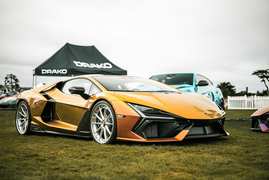
Lamborghini has always been synonymous with raw power, aggression, and automotive excess. The Revuelto, the successor to the legendary Aventador, manages to join the 1,000-horsepower club without abandoning its naturally aspirated V-12 heart. Instead, Lamborghini’s latest halo car incorporates a cutting-edge plug-in hybrid system that combines the high-revving 6.5-liter V-12 with three electric motors.
Two electric motors drive the front wheels, while a third is integrated into the eight-speed dual-clutch transmission, which helps keep the 3.8-kWh battery pack topped off. The Revuelto offers a stunning blend of brutal performance and remarkable refinement. It is far easier to drive than its predecessor, featuring a smooth dual-clutch gearbox and a seamless power delivery thanks to the hybrid system. Add improved ergonomics and plenty of Lamborghini flair, and you have a seriously compelling Italian hybrid that requires very little compromise—provided your wallet is deep enough.
Aston Martin Valkyrie: The Track-Focused Hybrid Hypercar
Aston Martin’s Valkyrie is a car that looks like it belongs on the racetrack rather than the road. Designed in collaboration with Red Bull Racing and legendary designer Adrian Newey, the Valkyrie is a street-legal hypercar that pushes the boundaries of automotive engineering. At its core is a 6.5-liter naturally aspirated V-12 engine that produces 1,001 horsepower and revs to a searing 11,000 rpm.
This monster mill is supplemented by a KERS-style hybrid system that adds another 141 hp and 207 lb-ft of torque for a total system output of 1,139 horsepower and 682 lb-ft of torque. All of this power is sent to the rear wheels in a car that weighs less than 3,000 pounds. The aerodynamic figures of the Valkyrie are equally staggering, producing 2,425 pounds of downforce at speeds between 137 and 220 mph, which is nearly half a ton more than a Formula 1 car. It’s an extreme machine by any measure, and anyone lucky enough to experience it will understand why it’s considered one of the most significant hypercars of the 21st century.
Mercedes-AMG S63 E Performance: The Rocket in a Suit
Mercedes-Benz is typically associated with luxury, refinement, and cutting-edge technology. When AMG gets its hands on the S-Class, however, the narrative changes dramatically. The S63 E Performance takes the plush comforts of the S-Class and injects them with a devastating dose of power. Outfitted with a 4.0-liter twin-turbo V-8 and a hybrid system that generates 201 hp and 236 lb-ft of torque, the S63 E Performance boasts a staggering total system output of 791 hp and 1,025 lb-ft of torque.
The prodigious grunt is sent to all four wheels, enabling this massive luxury sedan to challenge supercars in the sprint from 0 to 60 mph. Despite weighing nearly 6,000 pounds, the S63 E Performance maintains impressive composure when cornering, and it does so without resorting to an overly harsh suspension tune. It’s a testament to AMG’s engineering genius, proving that a hybrid powertrain can deliver exhilarating performance in a large luxury vehicle.
Audi RS6 Avant: The High-Performance Wagon
The fourth-generation Audi RS6 Avant isn’t a hybrid in the traditional sense, but its mild hybrid 48-volt belt alternator starter system plays a crucial role in its performance and efficiency. This system can harvest and store up to 12 kW of electrical energy, which powers the stop/start system at speeds up to 14 mph. It also enables the RS6 to coast for up to 40 seconds with the engine off at speeds between 35 mph and 100 mph if the driver lifts off the throttle

 Electrified Supercars: When Hybrids Deliver the Ultimate Performance Punch
Once associated with fuel-saving commuter cars, the term “hybrid” has undergone a radical transformation. The days of hybrids being synonymous with efficiency-only vehicles are long gone. Today, the automotive landscape is dominated by a new class of electrified supercars that blend cutting-edge electric technology with breathtaking performance, proving that hybrids are anything but boring.
From staggering horsepower figures to track-shattering lap times, these electrified marvels showcase a shift in automotive engineering, where battery power isn’t just about saving fuel; it’s about maximizing speed and style. With consumer interest in electric vehicles (EVs) fluctuating, hybrids are emerging as the perfect middle ground, offering a thrilling taste of the future without compromising on the driving experience.
This article delves into the most compelling hybridized supercars that redefine performance. These vehicles don’t just promise speed; they deliver it, mixing hypercar engineering with electric torque to create machines that push the boundaries of what’s possible on both the street and the racetrack.
The New Standard of Performance: Hybrid Supercars Redefined
For decades, the idea of a hybrid powertrain being used in a performance-oriented car seemed counterintuitive. Hybrid technology was synonymous with the Toyota Prius or the Honda Insight—vehicles designed to sip fuel and minimize emissions, not to provide heart-pounding acceleration. However, the automotive industry has witnessed a paradigm shift in recent years. The integration of electric motors into high-performance vehicles has proven that electrification can enhance, rather than diminish, the thrill of driving.
Modern hybrid supercars are engineering marvels. They combine internal combustion engines (ICE) with electric motors to achieve a synergy of power, efficiency, and responsiveness that was previously unimaginable. These aren’t just “faster Priuses”; they are ground-up designs where hybridization is central to the performance equation.
The shift is driven by two primary factors: market demand and technological advancement. Consumers are increasingly seeking vehicles that offer both exhilarating performance and environmental responsibility. At the same time, battery technology has become more advanced, offering higher energy densities and faster charging capabilities, allowing engineers to incorporate electric assistance without the crippling weight penalties of the past.
But what makes these cars so special? It’s not just about raw horsepower. It’s about how the electric power is integrated into the driving experience. Unlike traditional supercars, which rely solely on the mechanical power of their engines, hybrid supercars leverage the immediate torque of electric motors to eliminate turbo lag and enhance acceleration across the entire power band.
Electrified Supercars: When Hybrids Deliver the Ultimate Performance Punch
Once associated with fuel-saving commuter cars, the term “hybrid” has undergone a radical transformation. The days of hybrids being synonymous with efficiency-only vehicles are long gone. Today, the automotive landscape is dominated by a new class of electrified supercars that blend cutting-edge electric technology with breathtaking performance, proving that hybrids are anything but boring.
From staggering horsepower figures to track-shattering lap times, these electrified marvels showcase a shift in automotive engineering, where battery power isn’t just about saving fuel; it’s about maximizing speed and style. With consumer interest in electric vehicles (EVs) fluctuating, hybrids are emerging as the perfect middle ground, offering a thrilling taste of the future without compromising on the driving experience.
This article delves into the most compelling hybridized supercars that redefine performance. These vehicles don’t just promise speed; they deliver it, mixing hypercar engineering with electric torque to create machines that push the boundaries of what’s possible on both the street and the racetrack.
The New Standard of Performance: Hybrid Supercars Redefined
For decades, the idea of a hybrid powertrain being used in a performance-oriented car seemed counterintuitive. Hybrid technology was synonymous with the Toyota Prius or the Honda Insight—vehicles designed to sip fuel and minimize emissions, not to provide heart-pounding acceleration. However, the automotive industry has witnessed a paradigm shift in recent years. The integration of electric motors into high-performance vehicles has proven that electrification can enhance, rather than diminish, the thrill of driving.
Modern hybrid supercars are engineering marvels. They combine internal combustion engines (ICE) with electric motors to achieve a synergy of power, efficiency, and responsiveness that was previously unimaginable. These aren’t just “faster Priuses”; they are ground-up designs where hybridization is central to the performance equation.
The shift is driven by two primary factors: market demand and technological advancement. Consumers are increasingly seeking vehicles that offer both exhilarating performance and environmental responsibility. At the same time, battery technology has become more advanced, offering higher energy densities and faster charging capabilities, allowing engineers to incorporate electric assistance without the crippling weight penalties of the past.
But what makes these cars so special? It’s not just about raw horsepower. It’s about how the electric power is integrated into the driving experience. Unlike traditional supercars, which rely solely on the mechanical power of their engines, hybrid supercars leverage the immediate torque of electric motors to eliminate turbo lag and enhance acceleration across the entire power band.