Beyond the Prius: Electrified Supercars That Redefine Performance in 2025
The term “hybrid” used to conjure images of bland, earth-saving hatchbacks. Decades ago, the Toyota Prius cemented a stereotype of sensible, eco-friendly motoring—hybrids were boring, and that was that.
But the world of automotive engineering doesn’t stand still.
Fast-forward to 2025. The landscape has been utterly transformed. Every segment of the market, from family sedans to hypercars, now incorporates electrification. And as the demand for EVs fluctuates, it’s becoming increasingly clear that the future of performance isn’t about ditching gasoline; it’s about harnessing its power alongside electric assistance.
In fact, hybrid technology is now enabling the most extreme expressions of automotive engineering ever conceived. These aren’t just green cars; they are world-beating, jaw-dropping machines that blend brutal power with cutting-edge efficiency. For enthusiasts who dismissed electrification as a compromise, the modern performance hybrid offers a compelling rebuttal.
This article explores the electrifying elite—the hypercars, supercars, and high-performance sedans that are rewriting the rulebook. Prepare to witness speed, style, and attitude that will make you rethink everything you thought you knew about hybrids.
The American Muscle Reinvented: Chevrolet Corvette ZR1X
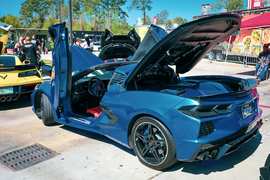
Corvettes have always punched above their weight class, but the ZR1X takes things to a level that embarrasses super-exotics costing multiple times more.
This is not just another Corvette. It’s a limited-production track weapon built for absolute supremacy. Beneath its aggressive aero-sculpted skin resides the beastly 5.5-liter twin-turbo flat-plane crank V-8 borrowed from the ZR1. However, it’s the enhanced hybrid system, inherited from the E-Ray, that elevates this machine to unprecedented performance heights.
The ZR1X is a monster, churning out a staggering 1,250 horsepower and 973 lb-ft of torque. With all-wheel drive propulsion, its acceleration is physics-defying. Chevrolet claims a 0-60 mph sprint in less than 1.7 seconds, placing it firmly in the hypercar stratosphere. In July 2025, it cemented its legacy by laying down a 6:49.275 lap time at the legendary Nürburgring, making it the fastest American production car ever to conquer the Green Hell.
While its MSRP places it at the pinnacle of Corvette pricing, the value proposition is undeniable. The ZR1X offers performance metrics that compete with million-dollar hypercars, solidifying its status as a benchmark for American engineering prowess. It’s a definitive statement that hybrid technology is essential for building the world’s fastest street cars.
The German Precision Hybrid: Porsche 911 GTS
For decades, purists feared the day Porsche would introduce a hybridized 911, but the 992.2 GTS T-Hybrid proves these fears were largely unnecessary.
Unlike traditional hybrids, the 911 GTS offers no all-electric driving capability. It utilizes a compact 1.9-kWh battery pack and an electric motor cleverly integrated into the turbocharger design (eTurbo). This isn’t about saving fuel; it’s about eliminating turbo lag.
The eTurbo spins independently of exhaust gas flow, generating boost pressure almost instantly when the driver demands power. Additionally, energy recovered during deceleration recharges the battery, and that stored energy assists the engine via a gearbox-mounted motor.
On the surface, the system sounds complex, but the results are stunning. The GTS delivers a linear, relentless surge of power that is remarkably familiar to 911 enthusiasts. The added performance is seamless, and the car drives with the purity and precision that defined the Porsche legacy. The fact that you likely wouldn’t even realize this is a hybrid without examining the badging is the ultimate testament to the engineering genius on display.
The V-12 Evolution: Lamborghini Revuelto
Lamborghini’s successor to the venerated Aventador managed to join the 1,000-horsepower club without sacrificing its legendary naturally aspirated V-12. The secret lies in the Revuelto’s plug-in hybrid system.
This supercar features two electric motors powering the front wheels and a third motor integrated into the revolutionary eight-speed dual-clutch transmission. The latter assists the 6.5-liter V-12, which revs to a spine-tingling 10,000 rpm, while the 3.8-kWh lithium-ion battery keeps the system charged.
Beyond the dramatic styling and terrifying performance, the Revuelto offers a level of refinement that its predecessor lacked. Where the Aventador’s automated single-clutch gearbox was notoriously unrefined, the Revuelto is smooth, civilized, and manageable in everyday driving. Much of this is thanks to the new dual-clutch transmission, but the hybrid powertrain provides near-seamless power delivery.
This Italian masterpiece blends high-tech hybrid performance with Lamborghini’s signature flair, offering a driving experience that requires very few compromises—provided you have the substantial budget to match its pedigree.
Le Mans on the Road: Aston Martin Valkyrie
The Aston Martin Valkyrie looks like something that should remain behind the pit lane at Circuit de la Sarthe, but this jaw-dropping hypercar is street-legal. It’s an automotive masterpiece that pushes the boundaries of what’s possible when road car engineering meets motorsport.
The Valkyrie is powered by a fearsome 6.5-liter naturally aspirated V-12 generating 1,001 horsepower on its own. This monstrous engine revs to a searing 11,000 rpm, but the real magic lies in its supplemental KERS-style hybrid system.
Developed with Cosworth, the hybrid unit adds another 141 hp and 207 lb-ft of torque, resulting in a total system output of 1,139 horsepower and 682 lb-ft of torque. All that power is sent exclusively to the rear wheels in a car weighing less than 3,000 pounds.
The aerodynamic figures are equally staggering. The Valkyrie generates 2,425 pounds of downforce between 137 and 220 mph, which is nearly half a ton more than a Formula 1 car. It’s an extreme machine in every definition, and it delivered a visceral driving experience that defines the pinnacle of performance hybrid engineering.
The Billionaire’s Sedan: Mercedes-AMG S63 E Performance
We typically associate the Mercedes S-Class with plush interiors and cutting-edge technology, but when AMG gets involved, the equation changes dramatically.
While its handsome exterior and opulent cabin might suggest a comfortable ride, the S63 E Performance delivers a brutal thrust that will shock the uninitiated. Outfitted with a 4.0-liter twin-turbo V-8 and a hybrid system that produces 201 hp and 236 lb-ft on its own, the S63 E Performance offers staggering output figures of 791 hp and 1,025 lb-ft of torque.
This immense torque is sent to all four wheels, enabling this large luxury sedan to challenge sports cars in the 0-60 mph sprint. Despite a curb weight approaching 6,000 pounds, the S63 E Performance remains composed when the road gets twisty, achieving this without resorting to an overly abusive suspension tune. It’s a demonstration that hybrid technology can enhance both speed and refinement in the luxury segment.
The Wagon That Eats Ferraris: Audi RS6 Avant
The fourth-generation Audi RS6 Avant isn’t a hybrid in the traditional sense, but its advanced 48-volt mild hybrid system represents a fascinating step in electrification.
This system can harvest and store up to 12 kW of electrical energy, enabling start-stop functionality at speeds up to 14 mph. More importantly, it allows the RS6 to coast for up to 40 seconds with the engine off at speeds between 35 and 100 mph if the driver lifts off the throttle.
Frankly, any opportunity to celebrate a 600-horsepower, track-tuned wagon is worth it. But for those craving even more electrification, the next-generation RS6 Avant is rumored to debut in 2027 with a full-fledged plug-in hybrid system, signaling that even Audi is evolving its performance hybrid portfolio.
The Ultimate Track Toy: Mercedes-AMG One
Mercedes-AMG’s ambitious project to create a road-legal Formula 1 car was fraught with development challenges, but the $2.7 million hybrid hypercar eventually set a new standard for road-legal track performance that likely won’t be eclipsed for years.
Its powertrain features a 1.6-liter turbo V-6 derived directly from the team’s F1 W06 Hybrid race car. This internal combustion engine works in conjunction with four electric motors, two of which drive the front wheels, for a total system output of 1,049 horsepower. A 8.4-kWh lithium-ion battery provides up

 Beyond the Prius: Electrified Supercars That Redefine Performance in 2025
The term “hybrid” used to conjure images of bland, earth-saving hatchbacks. Decades ago, the Toyota Prius cemented a stereotype of sensible, eco-friendly motoring—hybrids were boring, and that was that.
But the world of automotive engineering doesn’t stand still.
Fast-forward to 2025. The landscape has been utterly transformed. Every segment of the market, from family sedans to hypercars, now incorporates electrification. And as the demand for EVs fluctuates, it’s becoming increasingly clear that the future of performance isn’t about ditching gasoline; it’s about harnessing its power alongside electric assistance.
In fact, hybrid technology is now enabling the most extreme expressions of automotive engineering ever conceived. These aren’t just green cars; they are world-beating, jaw-dropping machines that blend brutal power with cutting-edge efficiency. For enthusiasts who dismissed electrification as a compromise, the modern performance hybrid offers a compelling rebuttal.
This article explores the electrifying elite—the hypercars, supercars, and high-performance sedans that are rewriting the rulebook. Prepare to witness speed, style, and attitude that will make you rethink everything you thought you knew about hybrids.
The American Muscle Reinvented: Chevrolet Corvette ZR1X
Corvettes have always punched above their weight class, but the ZR1X takes things to a level that embarrasses super-exotics costing multiple times more.
This is not just another Corvette. It’s a limited-production track weapon built for absolute supremacy. Beneath its aggressive aero-sculpted skin resides the beastly 5.5-liter twin-turbo flat-plane crank V-8 borrowed from the ZR1. However, it’s the enhanced hybrid system, inherited from the E-Ray, that elevates this machine to unprecedented performance heights.
The ZR1X is a monster, churning out a staggering 1,250 horsepower and 973 lb-ft of torque. With all-wheel drive propulsion, its acceleration is physics-defying. Chevrolet claims a 0-60 mph sprint in less than 1.7 seconds, placing it firmly in the hypercar stratosphere. In July 2025, it cemented its legacy by laying down a 6:49.275 lap time at the legendary Nürburgring, making it the fastest American production car ever to conquer the Green Hell.
While its MSRP places it at the pinnacle of Corvette pricing, the value proposition is undeniable. The ZR1X offers performance metrics that compete with million-dollar hypercars, solidifying its status as a benchmark for American engineering prowess. It’s a definitive statement that hybrid technology is essential for building the world’s fastest street cars.
The German Precision Hybrid: Porsche 911 GTS
Beyond the Prius: Electrified Supercars That Redefine Performance in 2025
The term “hybrid” used to conjure images of bland, earth-saving hatchbacks. Decades ago, the Toyota Prius cemented a stereotype of sensible, eco-friendly motoring—hybrids were boring, and that was that.
But the world of automotive engineering doesn’t stand still.
Fast-forward to 2025. The landscape has been utterly transformed. Every segment of the market, from family sedans to hypercars, now incorporates electrification. And as the demand for EVs fluctuates, it’s becoming increasingly clear that the future of performance isn’t about ditching gasoline; it’s about harnessing its power alongside electric assistance.
In fact, hybrid technology is now enabling the most extreme expressions of automotive engineering ever conceived. These aren’t just green cars; they are world-beating, jaw-dropping machines that blend brutal power with cutting-edge efficiency. For enthusiasts who dismissed electrification as a compromise, the modern performance hybrid offers a compelling rebuttal.
This article explores the electrifying elite—the hypercars, supercars, and high-performance sedans that are rewriting the rulebook. Prepare to witness speed, style, and attitude that will make you rethink everything you thought you knew about hybrids.
The American Muscle Reinvented: Chevrolet Corvette ZR1X
Corvettes have always punched above their weight class, but the ZR1X takes things to a level that embarrasses super-exotics costing multiple times more.
This is not just another Corvette. It’s a limited-production track weapon built for absolute supremacy. Beneath its aggressive aero-sculpted skin resides the beastly 5.5-liter twin-turbo flat-plane crank V-8 borrowed from the ZR1. However, it’s the enhanced hybrid system, inherited from the E-Ray, that elevates this machine to unprecedented performance heights.
The ZR1X is a monster, churning out a staggering 1,250 horsepower and 973 lb-ft of torque. With all-wheel drive propulsion, its acceleration is physics-defying. Chevrolet claims a 0-60 mph sprint in less than 1.7 seconds, placing it firmly in the hypercar stratosphere. In July 2025, it cemented its legacy by laying down a 6:49.275 lap time at the legendary Nürburgring, making it the fastest American production car ever to conquer the Green Hell.
While its MSRP places it at the pinnacle of Corvette pricing, the value proposition is undeniable. The ZR1X offers performance metrics that compete with million-dollar hypercars, solidifying its status as a benchmark for American engineering prowess. It’s a definitive statement that hybrid technology is essential for building the world’s fastest street cars.
The German Precision Hybrid: Porsche 911 GTS