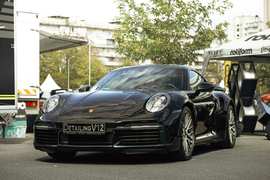
The Porsche 911: 5 Decades, 5 Legends, and the Enduring Spirit of Zuffenhausen
For more than six decades, the silhouette of the Porsche 911 has been an immutable icon of automotive engineering, a symbol of pure driving emotion that defies the conventions of time. It has transformed from a raw, uncompromising sports car into a sophisticated, technologically advanced machine, yet it has never lost its elemental soul.
For me, after spending countless hours behind the wheel of various iterations, the 911 is more than just a car; it’s a living entity. It’s a machine that forces you to pay attention, one that rewards respect with unparalleled performance and emotional engagement. It’s that tension, that delicate balance between German precision and German chaos, that defines the 911 experience.
Over my years of reviewing automobiles, I’ve encountered numerous Porsches. But there’s a distinct set of 911 models that have etched themselves into my memory. They represent the pinnacle of engineering, the birth of new eras, and the refinement of what makes the 911 the undisputed king of rear-engined performance. This is a journey through the evolution of an icon, exploring the five 911s that define its legendary status.
The Genesis: The 1975 Porsche 930 Turbo
There’s a certain mythos surrounding the first production Porsche 911 Turbo, the original 930. When I first heard veteran road-test journalists describe it, they spoke with a reverence that borders on fear. They spoke of a car that was unforgiving, a car that didn’t tolerate mistakes and demanded absolute precision from the driver. To them, it was the “widowmaker.”
It wasn’t until 35 years after my first encounter with a 911 that I finally got to drive one of these early Turbos. They are now part of Porsche’s coveted classic collection, and this one was one of the first 30 ever built. Stepping into the cabin, I was acutely aware of its fearsome reputation. I took it easy at first, tentatively feeding the throttle, feeling the subtle lag as the turbo spooled up, and trying to build a mental map of the power delivery.
The 3.0-liter flat-six was surprisingly tractable, happy to purr at just 2,000 rpm, cruising lazily at 45 mph in top gear. However, once the engine hit 3,500 rpm, the acceleration surged as the turbocharger pushed 0.8 bar into the induction system. But the shockwave I expected never came. There was no brutal, jarring jolt that modern turbocharged engines have perfected. Instead, there was a smooth but insistent shove that pushed me back into the seat.
I quickly learned that the trick to handling this beast smoothly was to keep the 3.0-liter engine spinning above 4,000 rpm. This keeps the turbocharger fully spooled, mitigating the dreaded turbo lag. While the lag is certainly noticeable compared to today’s standards, it’s entirely manageable. Even half a century later, the 930 is an astonishingly quick car on the road.
The first gear is good for 50 mph, second gear for 90 mph, and third gear extends to almost 130 mph. This means you can destroy most winding roads using only second and third gears. And despite having “only” 256 horsepower, it weighs just 2,513 pounds, making it remarkably nimble in the corners. Back in the mid-1970s, this level of performance was otherworldly. It cemented the 911 Turbo’s legendary status as the raw, untamed heart of the Porsche family.
The Perfect Marriage: The 1996 Porsche 993 Carrera
For Porsche purists, the 993 generation is the last bastion of the “real” 911. It’s the last air-cooled model, the one you drive with your knuckles grazing the dash while the mechanical symphony of a flat-six engine fills the cabin. But when the 993 was introduced in 1994, it wasn’t viewed as a nostalgic throwback; it was the Porsche of the future.
The 993 was the first 911 to truly challenge the laws of physics while retaining the classic 911 character. Yes, it still had that iconic, somewhat lively front end that demanded deliberate loading into corners, and the rear end still “rhumbaed” slightly on uneven surfaces. But the interaction between the front and rear was far more refined and forgiving than in its predecessors. The 993 still felt like a 911, but it operated within a much wider margin of error.
The secret to this improved handling was a revolutionary rear suspension. Porsche replaced the antiquated semi-trailing arms with a new multilink setup. This innovation allowed for very slight initial toe-out during corner entry, which then transitioned to progressive toe-in as lateral loads increased. Crucially, it minimized the camber change that had plagued 911s since their debut in 1963.
This breakthrough was paired with a steering system that was 16 percent quicker, reducing the lock-to-lock turns and making the front end feel significantly more decisive. The chassis was complemented by a new six-speed manual transmission, which extracted every ounce of performance from the 3.6-liter flat-six.
The engine itself was lighter and responded more keenly to throttle inputs, reaching its power peak of 268 horsepower at 6,100 rpm thanks to improved internals, Bosch Motronic 2.0 engine management, and a new dual exhaust system.
Under the leadership of Ulrich Bez (who would later head Aston Martin), the 993 was engineered for performance and reliability. And under the direction of design chief Harm Lagaay, the exterior received a stunning redesign. He corrected the visual issues of the 964, which he considered too nose-heavy and awkwardly proportioned. The interior was decluttered, moving buttons to more logical locations.
The 993 was faster, more forgiving, and more desirable than ever before. It remains the benchmark for air-cooled 911 purity, offering a driving experience that perfectly bridges the gap between raw analog feedback and modern mechanical capability.
The Resurgence: The 1996 Porsche 996
The launch of the 996-generation 911 was met with controversy. Porsche’s decision to switch to a water-cooled flat-six engine was, to the purists, an act of betrayal. It was like Bob Dylan trading his acoustic guitar for a Fender Stratocaster at the 1965 Newport Folk Festival—a radical departure from the established identity.
But for me, the 996 was a hero. It was the first clean-sheet redesign of Porsche’s iconic sports car in 34 years, and it saved the company.
Engineered under the direction of Porsche R&D chief Horst Marchart, the 996 was a masterpiece of efficiency and ingenuity. Its most significant innovation was sharing 38 percent of its components with the all-new Boxster roadster. Iconoclastic Porsche CEO Wendelin Wiedeking knew the Boxster was essential to provide dealers with something new to sell once the aging 928 and 968 models were retired. As design chief Lagaay famously said, “We did two cars for the price of one-and-a-half.”
While the automotive media obsessed over the relationship with the Boxster and the water-cooling technology, the 996’s true legacy runs deeper than its revolutionary engine. In 1994, it took Porsche 130 hours to build a 993. The 996, however, took just 60 hours to produce. The modern 911 had arrived.
It was roomier and packed with the features expected of a late 20th-century sports car, yet it was still unmistakably a Porsche. Most importantly, it still drove like a 911. Only better.
There was a new layer of sophistication to the 996’s execution, but it never lost the incredible tactility and urgent response that defined the 911 experience. It was responsive, precise, and confidence-inspiring. The 996 was the 911 that ensured the icon’s survival, proving that Porsche could innovate without sacrificing its soul. It successfully navigated the seismic shift from air-cooled exclusivity to modern engineering, all while remaining the definitive sports car.
The Modern Legend: The 2017 Porsche 991.2 Carrera
Of all the 911s I’ve ever driven, the base 991.2 Carrera is the one that truly captured my heart. It wasn’t the fastest or the most powerful model in the lineup. It was a simple, pure, rear-engined masterpiece that demonstrated what the 911 is all about.
At the time, press fleets were typically stacked with high-spec vehicles, loaded with every option imaginable. Porsche Cars North America’s decision to include a base Carrera among the models for our 2017 MotorTrend Car of the Year testing seemed like a bold gamble. In truth, it was an inspired move.
The 991.2 introduced a new 3.4-liter turbocharged engine, offering 370 hp in the base model and 42

 The Porsche 911: 5 Decades, 5 Legends, and the Enduring Spirit of Zuffenhausen
For more than six decades, the silhouette of the Porsche 911 has been an immutable icon of automotive engineering, a symbol of pure driving emotion that defies the conventions of time. It has transformed from a raw, uncompromising sports car into a sophisticated, technologically advanced machine, yet it has never lost its elemental soul.
For me, after spending countless hours behind the wheel of various iterations, the 911 is more than just a car; it’s a living entity. It’s a machine that forces you to pay attention, one that rewards respect with unparalleled performance and emotional engagement. It’s that tension, that delicate balance between German precision and German chaos, that defines the 911 experience.
Over my years of reviewing automobiles, I’ve encountered numerous Porsches. But there’s a distinct set of 911 models that have etched themselves into my memory. They represent the pinnacle of engineering, the birth of new eras, and the refinement of what makes the 911 the undisputed king of rear-engined performance. This is a journey through the evolution of an icon, exploring the five 911s that define its legendary status.
The Genesis: The 1975 Porsche 930 Turbo
There’s a certain mythos surrounding the first production Porsche 911 Turbo, the original 930. When I first heard veteran road-test journalists describe it, they spoke with a reverence that borders on fear. They spoke of a car that was unforgiving, a car that didn’t tolerate mistakes and demanded absolute precision from the driver. To them, it was the “widowmaker.”
The Porsche 911: 5 Decades, 5 Legends, and the Enduring Spirit of Zuffenhausen
For more than six decades, the silhouette of the Porsche 911 has been an immutable icon of automotive engineering, a symbol of pure driving emotion that defies the conventions of time. It has transformed from a raw, uncompromising sports car into a sophisticated, technologically advanced machine, yet it has never lost its elemental soul.
For me, after spending countless hours behind the wheel of various iterations, the 911 is more than just a car; it’s a living entity. It’s a machine that forces you to pay attention, one that rewards respect with unparalleled performance and emotional engagement. It’s that tension, that delicate balance between German precision and German chaos, that defines the 911 experience.
Over my years of reviewing automobiles, I’ve encountered numerous Porsches. But there’s a distinct set of 911 models that have etched themselves into my memory. They represent the pinnacle of engineering, the birth of new eras, and the refinement of what makes the 911 the undisputed king of rear-engined performance. This is a journey through the evolution of an icon, exploring the five 911s that define its legendary status.
The Genesis: The 1975 Porsche 930 Turbo
There’s a certain mythos surrounding the first production Porsche 911 Turbo, the original 930. When I first heard veteran road-test journalists describe it, they spoke with a reverence that borders on fear. They spoke of a car that was unforgiving, a car that didn’t tolerate mistakes and demanded absolute precision from the driver. To them, it was the “widowmaker.”