Toyota’s Sports Car Assault: A Deep Dive into the GR GT, GT3, and Lexus LFA
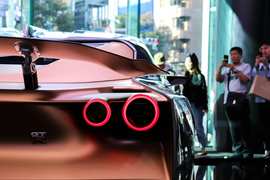
Toyota’s recent unveiling of its next-generation halo trio—the GR GT production car, the GR GT3 race car, and the all-electric Lexus LFA concept—sent shockwaves through the automotive world. This isn’t just about new metal; it’s a declaration of intent, a masterclass in heritage, and a strategic play for the future of the brand. By tasking engineers to build three distinct high-performance vehicles with unique powertrains, Chairman Akio Toyoda (Master Driver Morizo) is not just flexing Toyota’s manufacturing prowess, but offering the next generation of talent a chance to build world-class vehicles that will compete at the highest levels.
The GR GT: Homologation Powerhouse for the Road
The most anticipated road-legal offering is the GR GT, slated for production in 2027 (likely as a 2028 model). This is the homologated version of the GR GT3 race car, meaning the road-going variant must meet race specifications before the racer hits the track.
Pricing and Market Positioning
Pricing has been the subject of intense speculation. While Toyota remains tight-lipped, project manager Takashi Doi pointed to key competitors to provide context. Utilizing the GR GT’s claimed 641 hp and 3,858 lb curb weight (equating to a 6.0 lb/hp ratio), we can benchmark against current market leaders in the high-performance GT segment.
| Vehicle | Curb Weight | Horsepower | Weight/Power | Base Price |
| :— | :— | :— | :— | :— |
| 2028 Toyota GR GT | 3,858 lb | 641 hp | 6.0 lb/hp | N/A |
| 2026 Porsche 911 GT3 | 3,278 lb | 502 hp | 6.2 lb/hp | $235,500 |
| 2026 Porsche 911 Turbo S | 3,859 lb | 701 hp | 5.5 lb/hp | $275,650 |
| 2026 AMG GT Pro 4Matic | 4,299 lb | 603 hp | 7.1 lb/hp | $202,200 |
| 2026 Aston Martin Vantage S | 3,847 lb | 671 hp | 5.7 lb/hp | $235,000 |
Note: Indicates AWD models.
Based on this competitive landscape, the Toyota GR GT will almost certainly be priced above the $200,000 mark. Its weight-to-power ratio places it squarely against heavy hitters like the Aston Martin Vantage S and the massive AMG GT Pro 4Matic, while targeting the performance metrics of the 700+ horsepower Porsche 911 Turbo S.
Powertrain Complexity and Driving Dynamics
Under the hood lies a fiendishly complicated hybrid powertrain. This advanced system incorporates a mechanical limited-slip differential (LSD), offering drivers not just engaging driving dynamics but also the tire-scorching antics enthusiasts crave.
Will it drift? Doi-san confirmed that the team is developing different driving modes, but was cagey about specifics. A closer look at the GR GT’s steering wheel reveals a knob labeled ‘Sport Boost’ on the right, hinting at aggressive acceleration mapping. On the left side, a ‘TRC/VSC’ (Traction/Stability Control) button, with an “Off” option, suggests that drivers will have complete control to switch these systems off entirely.
Future Performance Variants
The question of future variants, such as Nürburgring Edition, GRMN, GT R, or GT3 RS models, was met with a characteristically Toyota response. Doi-san stated, “Obviously we can’t talk about future product, but variations and improvements is something we’re always looking for. And that’s crucial, very important for a sports car.” This isn’t a denial; it’s a confirmation that Toyota will leverage the GR GT platform for future high-performance iterations.
The Nürburgring Challenge: Humiliation to Redemption
Akio Toyoda’s introduction of the GR GT and GR GT3 was framed around the concept of ‘humiliation.’ He detailed his personal experiences driving Toyota sports cars (including a fourth-generation Supra) at the Nürburgring Nordschleife, where they were often passed by faster, better-handling vehicles, primarily from Germany.
This very concept of using humiliation as a catalyst for improvement drives the development of the GR GT and GT3. While Doi-san refused to commit to a sub-7-minute lap time, which has been recently achieved by the Mustang GTD (6:52), Corvette ZR1 (6:50), and ZR1X (6:49), he affirmed the Nürburgring’s critical importance to Toyota, the GR brand, and the company’s motorsports programs. He reiterated Akio’s stance: the GR GT will not be the one getting passed on the Green Hell.
Given the engineering ethos of Toyota and the performance benchmarks set by Porsche 911 GT3 and AMG GT models (all of which have beaten the 7-minute barrier), we believe this is essentially a declaration that the GR GT will achieve a sub-7-minute lap.
The Future of the Lexus LFA: EV Flagship with a Tech Twist
Fans awaiting the return of the LFA were met with a less concrete timeline. Toyota representatives indicated “several years” for the production debut of the LFA, with project manager Doi-san conceding the world has changed significantly since the original V10 supercar’s departure.
Pricing and the Solid-State Factor
The price of the new LFA will be the subject of much debate. As a successor to the first-generation LFA, which debuted in 2010 at a shocking $375,000 and reached $445,000 for the Nürburgring Edition, the next LFA must come back significantly cheaper. Doi-san implicitly acknowledged this shift by noting the evolution of the market.
The world of high-performance coupes has always been a niche market, and the emergence of electric vehicles has further complicated pricing. Currently, there are no electric sports coupes above $200,000. The few electric vehicles exceeding this threshold—such as the Lucid Air Sapphire, Rolls-Royce Spectre, and Cadillac Celestiq—do not align with the LFA’s competitive profile. If Lexus ventures into the realm of electric hypercars like the Rimac Nevera or Lotus Evija, the price would climb to $2.3 to $2.4 million, which is decidedly outside the Lexus target. The closest competitor is the second-generation Tesla Roadster, rumored to be in the $200,000 to $250,000 range, assuming it ever materializes.
However, one technological innovation could render the LFA a very expensive and exotic flagship: solid-state battery (SSB) technology. Although Toyota would not confirm this under direct questioning, it fits their strategic roadmap perfectly.
Toyota has been investing in solid-state batteries since 2020, through its joint venture with Panasonic, Prime Planet Energy & Solutions, Inc. In 2024, Toyota updated its battery plans, predicting the arrival of SSBs in 2027–2028, boasting a 621-mile (1000 km) range and 10-minute recharge times. This breakthrough performance would not only be a massive technological leap but also solve a significant packaging problem for the electric LFA.
Packaging the Powertrain
The standard practice in global EV manufacturing is to place heavy battery cells in a skateboard chassis—low in the floor, between the wheels. This keeps the center of gravity low for better handling. However, the all-aluminum spaceframe chassis shared by the GR GT, GR GT3, and LFA Concept lacks a traditional floorpan. It features thick structural members and a small cabin area ending at the rear bulkhead.
Could traditional lithium-ion cells be sandwiched ahead of the firewall or under the cabin? Perhaps they could occupy the engine bay, transmission tunnel, and cargo area after the GR GT’s hybrid V8 is removed? The use of “T-shaped” battery packs has been popular in the aftermarket EV scene, so anything is possible, especially with lighter, more energy-dense SSB technology. For packaging, performance, and marketing reasons, game-changing solid-state batteries debuting in the Lexus flagship makes a lot of sense. This could be the reason the production LFA’s debut is a long time away.
Fiendish Electromechanical Complexity: A Future-Focused Flex
The GR GT’s powertrain cutaway is a revelation in engineering complexity. Starting with an all-aluminum engine with forged internals (pistons, rods, and cross-plane crankshaft), twin turbochargers produce a claimed 641 horsepower and 627 lb-ft of torque.
This power is sent via a driveshaft enclosed in a carbon-fiber-reinforced plastic (

 Toyota’s Sports Car Assault: A Deep Dive into the GR GT, GT3, and Lexus LFA
Toyota’s recent unveiling of its next-generation halo trio—the GR GT production car, the GR GT3 race car, and the all-electric Lexus LFA concept—sent shockwaves through the automotive world. This isn’t just about new metal; it’s a declaration of intent, a masterclass in heritage, and a strategic play for the future of the brand. By tasking engineers to build three distinct high-performance vehicles with unique powertrains, Chairman Akio Toyoda (Master Driver Morizo) is not just flexing Toyota’s manufacturing prowess, but offering the next generation of talent a chance to build world-class vehicles that will compete at the highest levels.
The GR GT: Homologation Powerhouse for the Road
The most anticipated road-legal offering is the GR GT, slated for production in 2027 (likely as a 2028 model). This is the homologated version of the GR GT3 race car, meaning the road-going variant must meet race specifications before the racer hits the track.
Pricing and Market Positioning
Pricing has been the subject of intense speculation. While Toyota remains tight-lipped, project manager Takashi Doi pointed to key competitors to provide context. Utilizing the GR GT’s claimed 641 hp and 3,858 lb curb weight (equating to a 6.0 lb/hp ratio), we can benchmark against current market leaders in the high-performance GT segment.
| Vehicle | Curb Weight | Horsepower | Weight/Power | Base Price |
| :— | :— | :— | :— | :— |
| 2028 Toyota GR GT | 3,858 lb | 641 hp | 6.0 lb/hp | N/A |
Toyota’s Sports Car Assault: A Deep Dive into the GR GT, GT3, and Lexus LFA
Toyota’s recent unveiling of its next-generation halo trio—the GR GT production car, the GR GT3 race car, and the all-electric Lexus LFA concept—sent shockwaves through the automotive world. This isn’t just about new metal; it’s a declaration of intent, a masterclass in heritage, and a strategic play for the future of the brand. By tasking engineers to build three distinct high-performance vehicles with unique powertrains, Chairman Akio Toyoda (Master Driver Morizo) is not just flexing Toyota’s manufacturing prowess, but offering the next generation of talent a chance to build world-class vehicles that will compete at the highest levels.
The GR GT: Homologation Powerhouse for the Road
The most anticipated road-legal offering is the GR GT, slated for production in 2027 (likely as a 2028 model). This is the homologated version of the GR GT3 race car, meaning the road-going variant must meet race specifications before the racer hits the track.
Pricing and Market Positioning
Pricing has been the subject of intense speculation. While Toyota remains tight-lipped, project manager Takashi Doi pointed to key competitors to provide context. Utilizing the GR GT’s claimed 641 hp and 3,858 lb curb weight (equating to a 6.0 lb/hp ratio), we can benchmark against current market leaders in the high-performance GT segment.
| Vehicle | Curb Weight | Horsepower | Weight/Power | Base Price |
| :— | :— | :— | :— | :— |
| 2028 Toyota GR GT | 3,858 lb | 641 hp | 6.0 lb/hp | N/A |