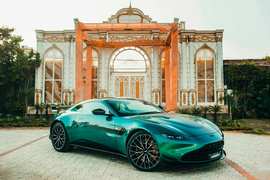
Aston Martin Valhalla: A 2025 Hypercar Masterpiece or A Marketing Fantasy?
“So, how was it?!”
An entirely predictable and proper question to ask of someone who’s just driven Aston Martin’s nearly $1.1 million, 1,064-horsepower Valhalla. But this decades-long auto publication tradition of reviewing supercars, perhaps always somewhat of a frivolous endeavor, has in relatively recent times taken an even more acute turn into the surreal.
So much so that when at least four different friends/colleagues asked me that question the day after a drive of the 2026 Aston Martin Valhalla, I hesitated briefly before replying with some version of, “Er, exactly how you expect it be.” I recognized almost immediately that while this wasn’t meant to be whatsoever flippant, it only makes any iota of sense if you’ve been fortunate enough to experience the state of the supercar art for yourself here in the once inconceivable 2020s.
A Long Time Coming
Seven years weirdly feels like more than a lifetime ago, no doubt exacerbated by the mind-screw of the isolated pandemic years that, for many, caused time to cease being linear. But that’s how long it’s been since the 2019 Geneva Motor Show where Aston first presented what was then dubbed the AM-RB 003.
That original name, which has since changed to one from Norse mythology (Valhalla is the glorious afterlife realm where heroic dead warriors’ spirits go to prepare for an epic final battle; it also conveniently begins with a V, keeping with one of Aston’s traditional naming conventions), was a reflection of the automaker’s then-sponsorship ties to the Red Bull Racing Formula 1 team.
A lot has changed since, and not just the name. Aston and Red Bull cut ties following the 2020 F1 season after the former’s then-new boss Lawrence Stroll binned his Racing Point F1 team’s name in favor of branding it as the famous British marque. More importantly, the automotive landscape was evolving quickly, as was Aston.
There was chaotic turnover within the internal ranks, and the Valhalla’s hybrid powertrain—first planned as an in-house-designed turbocharged 3.0-liter V-6 with performance to match certain other, then-more-relevant hybrid hypercars like the LaFerrari and Porsche 918 Spyder—became a hybridized Mercedes-AMG GT Black Series-derived twin-turbo V-8. (Compared to the GT Black Series, Aston gives it bigger turbos, a new inlet manifold, stronger pistons, and different camshafts to bump the output by nearly 100 hp and 50 lb-ft; the Valhalla is now the exclusive home of this engine.)
When I sat in a mockup of the car on the Pebble Beach Concours’ lawn in August 2022, giggling at the Valhalla’s F1-inspired reclined and elevated-leg seating position, the projected specs for the V-8-based powertrain had jumped from a combined 937 horsepower and 738 lb-ft of torque to 1,012 hp and an undisclosed torque figure. None of this was finalized, Aston said, but it was all more than enough to cause me to say, “Please, I want to drive it, whenever it’s ready.”
Worth the Wait… But Something Else Happened Along the Way
Based on what Aston Martin said at that time about the Valhalla’s development cycle, I didn’t think another three and a half years would pass before I got the chance, but the production version’s hardware exceeds all those earlier expectations.
The flat-plane-crank, dry-sump, twin-turbo 4.0-liter V-8 makes 817 hp; combined with a total of 248 hp provided by two Aston-designed radial-flux permanent-magnet motors on the front axle and a third mounted to and working inside the new eight-speed dual-clutch gearbox (an Aston first), peak outputs are 1,064 hp and 811 lb-ft.
Along with the motors, the hybrid system is comprised of a 560-cell battery pack (engineers say it’s an off-the-shelf AMG battery that’s the only part of the hybrid system Aston doesn’t make) kept cool by immersing the cells completely in dielectric oil. The simplified upshot of the latter is, as chief engineer Andrew Kay told us, “We’re able to push energy into the battery and cycle it out very quickly [meaning recharge and deployment of electrical energy]. This is very good for track use, in particular.”
Unlike the original Valhalla concept and its Valkyrie big brother, the production model is also a plug-in hybrid, capable of driving the car in EV-only mode for up to 8.7 miles and an 80-mph top speed.
The 2025 Performance Landscape: A New Definition of “Madness”
If there’s a relative disappointment that supercar/hypercar aficionados and owners might point to, it’s the lack of ultra-high revs this powertrain produces with its redline set to 7,000 rpm. Then there’s the concert itself, a multifaceted mix of electric motors, turbos, induction, and exhaust. In totality, it’s loudish without being over the top, which is satisfying when your right foot opens the floodgates, but no one is ever going to include this on a list of best-sounding engines for the ages—there’s just a lot going on, and not for the audibly better.
In the current automotive landscape of 2025, the concept of a hypercar has been stretched to its breaking point, primarily by the Valhalla’s spiritual sibling, the Valkyrie, and the rapidly evolving, 1,000+ hp “hyper-hybrid” segment. As a car enthusiast and automotive journalist with over a decade of hands-on experience, I can attest that the Valhalla occupies a unique niche. It’s Aston Martin’s first mid-engine supercar, and by their own definition, this places it in a different, if not slightly less extreme, league than the Valkyrie, which is frankly closer to a Formula 1 car with license plates.
Defining the 2025 Hypercar Hierarchy
The Apex Predator (Valkyrie, LaFerrari): These are the halo cars, the thousand-unit halo machines that push the boundaries of physics as we know it. They boast extreme aerodynamics, ultra-lightweight construction, and the highest performance metrics on the planet. The Valkyrie, starting at over $3 million, is a street-legal race car with hybrid hypercar technology that fundamentally challenges the definition of road-legal automotive engineering.
The Advanced Hybrid Supercar (Valhalla, Porsche 918 Spyder, McLaren P1): This is where the Valhalla sits. Starting around $1.1 million, it uses hybrid technology that makes it a plug-in hybrid capable of EV-only mode for up to 8.7 miles. It features a flat-plane-crank, dry-sump V8 engine (817 hp) and powerful electric motors (247 hp) that provide torque vectoring for incredible cornering stability. This category represents the peak of what’s achievable in modern high-performance luxury cars—a balance of extreme performance and usability that was once science fiction.
The High-Tech Performance Machine (Ferrari F80, Czinger 21C VMax): These cars are pushing the boundaries of aerodynamics and sustainable supercars. The F80’s 815-hp turbo V8 and 833 hp electric motors are paired with active aerodynamics that can produce over 1,000 pounds of downforce. The Czinger 21C VMax pushes efficiency and performance to the extreme with its 1,380-hp twin-turbo V8 and revolutionary 3D-printed alloy components.
The “Practical” Performance Car (Ferrari 849 Testarossa, Corvette ZR1X): These are performance cars that are easier to live with. The Ferrari 849 Testarossa offers a V12 with a mild-hybrid system, bridging the gap between old-school supercars and modern technology. The Corvette ZR1X pushes performance to an almost absurd level for a production car with a hybrid setup delivering 1,250 hp, and it is a true sports car that defies its price point.
The Valhalla on the Road: A Surprise of Usability
You want to run the car in Race mode, not because it’s named as such and because you’re on a racetrack, but because of how the hybrid system operates. In Sport+ on the road, because drivers aren’t usually asking for full power in big long bursts, this mode dumps a huge amount of electric boost to the wheels, draining the battery at a quick rate that the brake-by-wire system then recovers so you’re ready to go again the next time.
However, on a track when you’re constantly pressing the throttle as quickly, hard, and often as possible, Race mode meters the electric assist via a recharge strategy that holds back up to 15 percent state of charge to protect you from ever running

 Aston Martin Valhalla: A 2025 Hypercar Masterpiece or A Marketing Fantasy?
“So, how was it?!”
An entirely predictable and proper question to ask of someone who’s just driven Aston Martin’s nearly $1.1 million, 1,064-horsepower Valhalla. But this decades-long auto publication tradition of reviewing supercars, perhaps always somewhat of a frivolous endeavor, has in relatively recent times taken an even more acute turn into the surreal.
So much so that when at least four different friends/colleagues asked me that question the day after a drive of the 2026 Aston Martin Valhalla, I hesitated briefly before replying with some version of, “Er, exactly how you expect it be.” I recognized almost immediately that while this wasn’t meant to be whatsoever flippant, it only makes any iota of sense if you’ve been fortunate enough to experience the state of the supercar art for yourself here in the once inconceivable 2020s.
Aston Martin Valhalla: A 2025 Hypercar Masterpiece or A Marketing Fantasy?
“So, how was it?!”
An entirely predictable and proper question to ask of someone who’s just driven Aston Martin’s nearly $1.1 million, 1,064-horsepower Valhalla. But this decades-long auto publication tradition of reviewing supercars, perhaps always somewhat of a frivolous endeavor, has in relatively recent times taken an even more acute turn into the surreal.
So much so that when at least four different friends/colleagues asked me that question the day after a drive of the 2026 Aston Martin Valhalla, I hesitated briefly before replying with some version of, “Er, exactly how you expect it be.” I recognized almost immediately that while this wasn’t meant to be whatsoever flippant, it only makes any iota of sense if you’ve been fortunate enough to experience the state of the supercar art for yourself here in the once inconceivable 2020s.