The Unexpected Titans: Supercars That Redefined the Hybrid Narrative
For years, the word “hybrid” conjured images of sensible sedans, eco-conscious commuters, and a distinct lack of automotive thrills. Vehicles like the early Toyota Prius cemented the notion that electrification was solely about fuel efficiency and reduced emissions, relegating hybrids to the sidelines of the performance world. Enthusiasts often viewed them with skepticism, if not outright disdain, wondering if true power and cutting-edge engineering had abandoned the pursuit of gasoline-fueled fury.
But the times, they are a-changin’.
Today, the landscape of high-performance motoring is undergoing a seismic shift. As the automotive industry navigates the complex transition to electric vehicles, the lines between traditional powerplants and advanced electrification are becoming increasingly blurred. Demand for pure EVs has cooled, leaving manufacturers to innovate in the realm of performance hybridization. The result? A new wave of automotive marvels that challenge our preconceived notions of what a hybrid can be.
Forget the mundane. Forget the boring. From track-focused legends to luxury speedsters, these electrified supercars prove that you don’t have to sacrifice swagger for sustainability. They are the unexpected titans of the modern era, each delivering a blistering cocktail of speed, style, and jaw-dropping technology. If you thought hybrids were relegated to the slow lane, prepare to be proven wrong. These are the machines that are fundamentally redefining the future of performance, and they are absolutely electrifying.
The Electric Enigma: How Hybrids Evolved from Eco-Cars to Supercars
The journey from a car with good gas mileage to a hybrid supercar is a fascinating tale of engineering evolution. While early pioneers focused on efficiency, the next generation of engineers recognized the untapped potential of electric motors. They realized that adding an electric motor didn’t just reduce consumption; it could also create torque in ways internal combustion engines never could.
The paradigm shift began when automakers understood that hybrid power offered a dual advantage: raw power and instant torque. By integrating electric motors with traditional engines, engineers could achieve staggering horsepower figures while maintaining reasonable fuel economy. The era of hybrid exotics had officially begun, and the enthusiasts who were once skeptical found themselves eagerly awaiting the next release.
The Current Contenders: America’s New Super Hybrid Speedsters
The American automotive landscape is currently hosting some of the most exciting developments in hybrid technology. With manufacturers pushing the boundaries of what’s possible, it’s no surprise that the United States is home to some of the most powerful and sophisticated hybrid supercars on the planet.
Leading the charge is the Chevrolet Corvette ZR1X. While the Corvette has always packed a punch, the ZR1X takes things to an entirely different level. Equipped with the ZR1’s 5.5-liter twin-turbo flat-plane crank V-8 engine and an enhanced version of the Corvette E-Ray’s hybrid system, the all-wheel-drive ZR1X cranks out a massive 1,250 horsepower and 973 lb-ft of torque. That power is enough to propel the car from 0 to 60 mph in less than 1.7 seconds.
However, what makes the ZR1X truly remarkable is its lap time at the Nürburgring in July 2025. It completed a 6:49.275 lap, which currently makes it the fastest American production car on the famed German racetrack. Although its base MSRP of $207,305 makes it the most expensive Corvette in history, it remains a performance bargain, capable of embarrassing exotics that cost several times more.
Another exceptional hybrid from the United States is the McLaren Speedtail. While many associate McLaren with lightweight, pure-speed machines, the Speedtail introduces a hybrid powertrain to the lineup. Powered by a twin-turbo V-8 and a rear-mounted electric motor, the Speedtail delivers a combined output of 1,036 horsepower. This allows the car to reach staggering speeds of over 250 mph, making it one of the fastest production cars in the world.
Germany’s Hybrid Powerhouses: Engineering the Future of Performance
Germany has long been synonymous with automotive excellence, and their approach to hybrid supercars is no exception. From the legendary halls of Porsche to the high-tech labs of Mercedes-AMG, German engineers are pushing the boundaries of what’s possible with hybrid technology.
For years, Porsche fanatics feared the day when the 911 would inevitably receive an electrified powertrain. However, the Porsche 911 GTS T-Hybrid has proven that these fears were much ado about nothing. Unlike many other hybrid models, the 911 GTS T-Hybrid offers no all-electric driving range. With a tiny 1.9-kWh battery pack on board, the weight penalty is virtually unnoticeable from behind the wheel. What is noticeable, however, is the lack of turbo lag. The electric motor has been integrated into the turbocharger’s design, allowing it to spin the turbo independently of exhaust gas flow. This means it can produce boost pressure almost instantly.
The power recovered by the eTurbo also helps recharge the battery, and the stored energy assists the engine through the gearbox motor. While the system might sound complicated, the results speak for themselves. The 911 GTS T-Hybrid delivers a driving experience that is both thrilling and seamless, proving that you don’t have to sacrifice performance for efficiency.
Mercedes-AMG has also made a significant contribution to the world of hybrid supercars with the Mercedes-AMG One. Although this vehicle’s development was fraught with teething issues during its initial rollout, the $2.7 million hybrid hypercar eventually set a new bar for road-legal track performance. Its powertrain combines a 1.6-liter turbo V-6 derived from the team’s F1 W06 Hybrid race car with four electric motors. The total system output stands at 1,049 horsepower.
An 8.4-kWh lithium-ion battery pack provides up to 11 miles of all-electric range, while a seven-speed single-clutch automated manual transmission handles the gear changes. The AMG One features a carbon monocoque and carbon-fiber bodywork to keep the car lightweight. With five-link suspension setups at both the front and rear paired with pushrod-activated Multimatic dampers, the AMG One is capable of handling as well as it accelerates.
Italy’s Electrifying Beasts: Luxury, Speed, and V12 Power
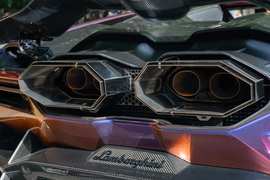
Italy has long been a global leader in the world of supercars, and their latest offerings are no exception. Lamborghini’s successor to the Aventador, the Revuelto, has managed to join the 1,000-horsepower club without abandoning its naturally aspirated V-12 engine. Thanks to the Revuelto’s plug-in hybrid system, two electric motors drive the front wheels while another is integrated into the flagship’s eight-speed dual-clutch transmission. The latter assists the 6.5-liter V-12, which revs to nearly 10,000 rpm and helps keep the 3.8-kWh lithium-ion battery pack topped off.
Setting aside the Revuelto’s jaw-dropping styling and stunning performance for a moment, it should also be noted that it’s far easier to live with than its predecessor. While the Aventador’s automated single-clutch transmission was woefully unrefined during everyday driving situations, the Revuelto is an entirely different story. Much of that can be attributed to the new dual-clutch gearbox, but the hybrid system deserves credit for the near seamless power delivery. Add some vastly improved ergonomics and plenty of Lamborghini flair to the mix, and you have a seriously compelling Italian hybrid that requires very little compromise—provided your pockets are deep enough.
For those seeking the pinnacle of performance with a focus on cutting-edge technology, the Ferrari 296 GTB is a worthy contender. Combining a 3.0-liter twin-turbo V-6 with a hybrid system that produces 167 horsepower, the GTB offers a staggering combined output of 819 horsepower and 546 lb-ft of torque. The car accelerates from 0 to 60 mph in 2.9 seconds and has a top speed of over 205 mph.
The British Comeback: Aston Martin and McLaren Redefine Power
The United Kingdom has a long history of producing some of the world’s most beautiful and high-performance automobiles. In recent years, Aston Martin and McLaren have both introduced new hybrid supercars that combine cutting-edge technology with stunning design.
Aston Martin’s jaw-dropping Valkyrie might look like something you’d expect to see rolling out of a paddock at Le Mans, but it’s actually a street-legal hypercar. Outfitted with a 6.5-liter naturally aspirated V-12 that generates 1,001 horsepower on its own and revs to a searing 11,000 rpm, the Valkyrie’s monster mill is supplemented by a KERS-style hybrid setup that adds another 141 hp and 207 lb-ft of torque for a total system output of 1,139 horsepower and 682 lb-ft of torque. All of which is sent to the rear wheels in a car with a curb weight of less than 3,000 pounds.
The aerodynamic figures of this track-bred car are equally staggering. The Valkyrie generates 2,425 pounds of downforce from 137 to 220 mph, which is nearly half a ton more than a Formula 1 car

 The Unexpected Titans: Supercars That Redefined the Hybrid Narrative
For years, the word “hybrid” conjured images of sensible sedans, eco-conscious commuters, and a distinct lack of automotive thrills. Vehicles like the early Toyota Prius cemented the notion that electrification was solely about fuel efficiency and reduced emissions, relegating hybrids to the sidelines of the performance world. Enthusiasts often viewed them with skepticism, if not outright disdain, wondering if true power and cutting-edge engineering had abandoned the pursuit of gasoline-fueled fury.
But the times, they are a-changin’.
Today, the landscape of high-performance motoring is undergoing a seismic shift. As the automotive industry navigates the complex transition to electric vehicles, the lines between traditional powerplants and advanced electrification are becoming increasingly blurred. Demand for pure EVs has cooled, leaving manufacturers to innovate in the realm of performance hybridization. The result? A new wave of automotive marvels that challenge our preconceived notions of what a hybrid can be.
Forget the mundane. Forget the boring. From track-focused legends to luxury speedsters, these electrified supercars prove that you don’t have to sacrifice swagger for sustainability. They are the unexpected titans of the modern era, each delivering a blistering cocktail of speed, style, and jaw-dropping technology. If you thought hybrids were relegated to the slow lane, prepare to be proven wrong. These are the machines that are fundamentally redefining the future of performance, and they are absolutely electrifying.
The Unexpected Titans: Supercars That Redefined the Hybrid Narrative
For years, the word “hybrid” conjured images of sensible sedans, eco-conscious commuters, and a distinct lack of automotive thrills. Vehicles like the early Toyota Prius cemented the notion that electrification was solely about fuel efficiency and reduced emissions, relegating hybrids to the sidelines of the performance world. Enthusiasts often viewed them with skepticism, if not outright disdain, wondering if true power and cutting-edge engineering had abandoned the pursuit of gasoline-fueled fury.
But the times, they are a-changin’.
Today, the landscape of high-performance motoring is undergoing a seismic shift. As the automotive industry navigates the complex transition to electric vehicles, the lines between traditional powerplants and advanced electrification are becoming increasingly blurred. Demand for pure EVs has cooled, leaving manufacturers to innovate in the realm of performance hybridization. The result? A new wave of automotive marvels that challenge our preconceived notions of what a hybrid can be.
Forget the mundane. Forget the boring. From track-focused legends to luxury speedsters, these electrified supercars prove that you don’t have to sacrifice swagger for sustainability. They are the unexpected titans of the modern era, each delivering a blistering cocktail of speed, style, and jaw-dropping technology. If you thought hybrids were relegated to the slow lane, prepare to be proven wrong. These are the machines that are fundamentally redefining the future of performance, and they are absolutely electrifying.